
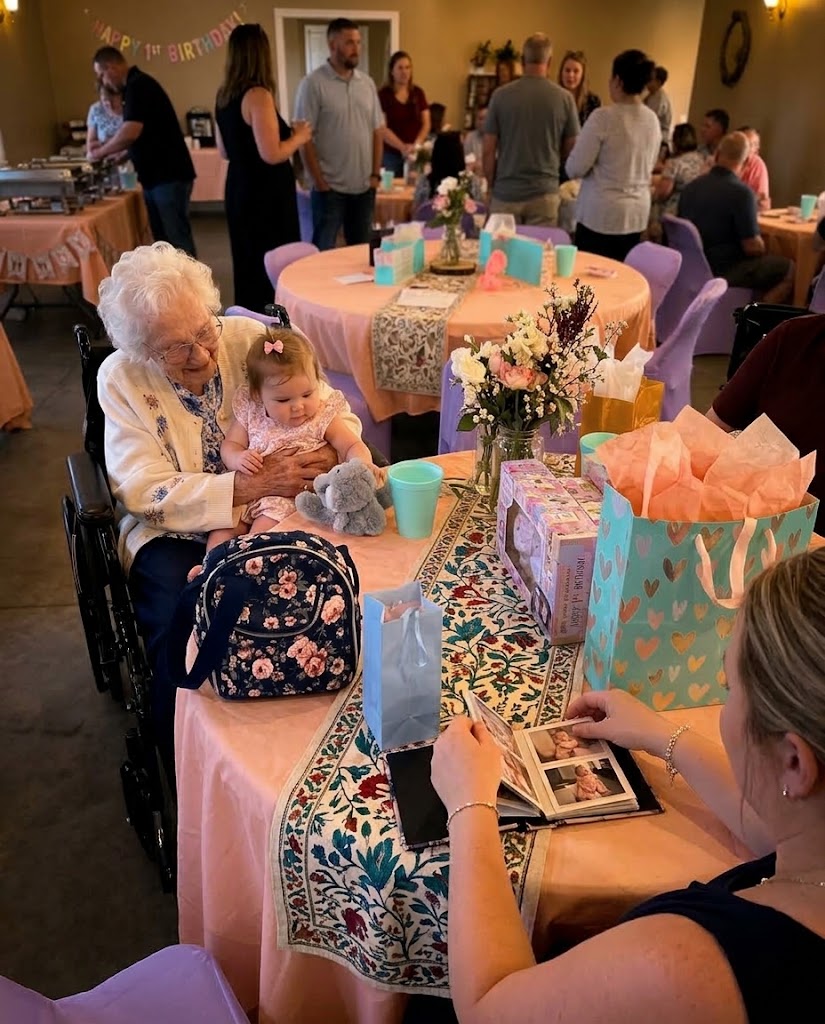
“Not yet,” Grandma whispered when I reached for the package hanging from her wheelchair. At 101, she could no longer walk, could barely hold my one-year-old daughter Lily without my husband supporting her from behind, and had endured a ninety-minute car ride everyone in the family thought was too much for her. Yet there she sat beneath the apple tree at Lily’s birthday party, watching my daughter as though the rest of us had disappeared. “Wait until everybody’s here,” she insisted, refusing to let me open the bag until my mother came outside. Inside was Grandma’s battered walnut sewing box—the one that had lived beside her chair throughout my childhood, filled with pearl buttons, colored thread, needles, and mysterious parcels I had never been allowed to touch. Beneath the top tray lay a white dress embroidered with yellow flowers that I had worn at four, then a pale-blue hand-smocked dress my mother had worn at two. Under those was a third dress: cream linen stitched with tiny green leaves, unfinished, with one sleeve still missing. “That’s hers,” Grandma said, looking at Lily. Then she told me to check inside the hidden fold at the waist.
There was a letter addressed to me in handwriting shakier than I remembered. Its first line read, For the baby I hope I live long enough to meet. Seven years earlier, when I was thirty-four and two years into trying to become a mother, our first fertility treatment had failed. I had sat at Grandma’s kitchen table and admitted that perhaps motherhood simply was not going to happen for me. She had not offered clichés or promised a miracle; she only said, “Maybe. But today isn’t every day.” What I never knew was that after I left, she went home and began sewing. In the letter she explained that she had not made the dress because she knew a baby would come. “I made it because hope needs somewhere to sit while it waits,” she wrote, adding that if no child ever wore it, my life would still have been complete. She finished most of the dress when she was ninety-four, but arthritis eventually made the fine work impossible. The missing sleeve was deliberate in another sense: “I thought perhaps one day you could finish something I started.” Then came the line that reached deepest into the fear I had carried since a fourteen-week pregnancy loss and through Lily’s first year: Do not save these things so carefully that nobody gets to live in them. Clothes are meant to wrinkle. Children are meant to stain things. Love is not improved by keeping it untouched.
Grandma stayed less than two hours that afternoon. She ate half my cake after refusing her own slice, watched Lily smash frosting between both hands, and declared the exhausting journey “obviously” worthwhile. Before my uncle wheeled her away, she squeezed my hand and ordered me to finish the sleeve. I bought a beginner sewing kit three days later and discovered that loving an heirloom does not magically give you sewing talent. My mother was equally useless, which meant two generations of women had spent decades benefiting from Grandma’s skill while resisting every attempt she made to teach us. Eventually we found her old sewing machine, and for six weeks I worked after Lily went to bed. Grandma remained an unforgiving supervisor. My first sleeve seam was terrible; she made me remove it after two hours of work. “Then you’ll be faster the second time,” she said. I redid the sleeve twice and the collar three times. When Lily was thirteen months old, the cream dress finally fit over her shoulders. My stitching was nowhere near Grandma’s. But the sleeve was attached.
We took Lily to Grandma’s house and placed her on the same front step where I had once been photographed in the yellow-flowered dress. My mother stood nearby holding her own childhood picture. Grandma waited in the doorway in her wheelchair while Mark tried increasingly ridiculous noises behind the camera until Lily finally stopped crawling long enough to look up. One click gave us what Grandma had been waiting for: my mother at two in pale blue, me at four in white and yellow, and Lily at one in cream and green—three little girls, three different decades, all wearing clothes made by the same pair of hands. Grandma ordered me to print the photograph because, according to her, nobody printed anything anymore. I did. The next time I visited, it was framed beside my childhood picture near her chair. Grandma died quietly four months later at 101 years and seven months. I arrived twenty minutes too late and spent a long time wishing for one more correction, one more instruction, one more chance to hear that I was doing something improperly. Eventually I understood she had been saying goodbye in pieces for years: the box, the letter, the unfinished dress, the birthday, and that photograph.
The sewing box lives in my house now, and the dresses are no longer treated like museum pieces. Lily has stained the cream one with strawberry, and she tore my old yellow dress on a branch during family photographs; I repaired it badly but well enough. On Lily’s second birthday, after everyone had gone home, I found a tiny scrap of cream fabric hidden at the bottom of Grandma’s box. Across it were three attempts at the green leaf pattern from Lily’s dress. The first leaf was crooked. The second was worse. The third was almost right. Grandma had been sewing for nearly ninety years when she made that garment, and apparently even she still practiced before committing needle to cloth. I framed the scrap because it changed how I remember her. She had never been fearless or magically certain; she simply continued until the next stitch held. When motherhood frightens me now—when Lily climbs too high, catches a fever, or awakens that old impulse to protect something I waited so long to have—I think about Grandma enduring that car ride at 101 and about the sleeve she deliberately left unfinished. She did not need to complete everything herself. She only needed to leave enough for somebody else to continue. Maybe that is what a family inheritance really is: not a perfect thing preserved untouched in a box, but unfinished work passed carefully from one pair of hands to the next.

