
The church clock read 3:41 when my almost-sister-in-law appeared in the doorway, holding an envelope as though it might burn her fingers. My bouquet lay across my lap, its damp stems darkening the white fabric of my wedding dress, while the radiator beside Grandma June’s chair clicked and hissed. Somewhere beyond the closed door, the organist had finally stopped playing, leaving a silence more unbearable than the music. Tammy’s mascara had streaked down her cheeks, and she couldn’t bring herself to look directly at me. “Mom says you need to give the ring back today,” she whispered, before adding that her family expected me to repay nine thousand dollars for the rehearsal dinner and honeymoon cruise. I stared at the figures penciled onto the back of a church offering envelope: $2,100 for supper, $6,900 for the cruise, and a total carefully underlined twice. My groom, Derrick, had already informed his brother by text message that he wasn’t coming, and now his mother was sending me a bill while 140 wedding guests waited in the sanctuary. At thirty-one years old, I had imagined almost every detail of my wedding day, but never that I would be sitting in my bridal gown wondering how much an abandoned bride was supposed to owe.
My name is Amy Jo, and I live in Chanute, Kansas, where people still remember what your grandmother served at a church supper twenty years ago. I’d worked at the pharmacy counter for nine years and dated Derrick for four, long enough to believe I understood the man I was supposed to marry. His mother, Lorna, had always treated me kindly, teaching me family recipes and sitting beside me for six nights in a Wichita hospital when my own mother was dying. She even gave Derrick her mother’s engagement ring to propose with, a modest round diamond set in yellow gold in 1948. The ring had never been about money to me; I treasured it because Lorna had entrusted me with something that belonged to her family’s history. My father, Ray, was sixty-six, a retired cement-plant maintenance worker and Gulf War veteran who rarely spoke more than necessary. He had bought his first new suit since my mother’s funeral so he could walk me down the aisle, and he had personally paid $4,900 for the catered reception dinner and another $1,500 for a four-piece band. The celebration was arranged for 140 people at the local VFW hall, where Aunt Deb had prepared an elaborate cake and the auxiliary volunteers had decorated the tables with white streamers and jars of autumn flowers. At three o’clock, I was supposed to walk down the aisle. Instead, the organist kept repeating the same hymns while my cousin Beth, the maid of honor, slipped in and out of the bridal room with increasingly strained explanations. At 3:20, Derrick’s brother Jeff arrived holding his phone. Derrick had texted him, “I can’t. Tell her I’m sorry.” I called Derrick eleven times, but every attempt went directly to voicemail. Jeff eventually reached him and learned that he was sitting in his pickup at the lake where he liked to fish, perfectly safe and simply unwilling to come to the wedding. Derrick refused to explain himself and turned off his phone. When Daddy heard, he offered to drive to the lake and bring him back, but I stopped him. Whatever love I had believed we shared, I knew I couldn’t begin a marriage by having my father drag an unwilling groom into a church. Grandma June, eighty-four and practical enough to make difficult decisions before anybody else had finished worrying, asked what was happening to the meal waiting at the VFW. When Daddy explained that the roast beef, potatoes, green beans, and rolls were already cooked and the band had been paid, she reminded me that 140 people had traveled to celebrate with us and hadn’t eaten since noon. Then she admitted that she herself had never enjoyed a proper wedding dance; she and Grandpa had married quietly in 1962 and gone home to milk the cows. Looking at my father’s new suit, my grandmother’s determined expression, and the white satin heels pinching my feet, I made a decision. I removed the heels, put on the canvas sneakers I’d packed for dancing, and asked Beth to bring me my handbag. There wasn’t going to be a wedding, but there was still going to be supper.
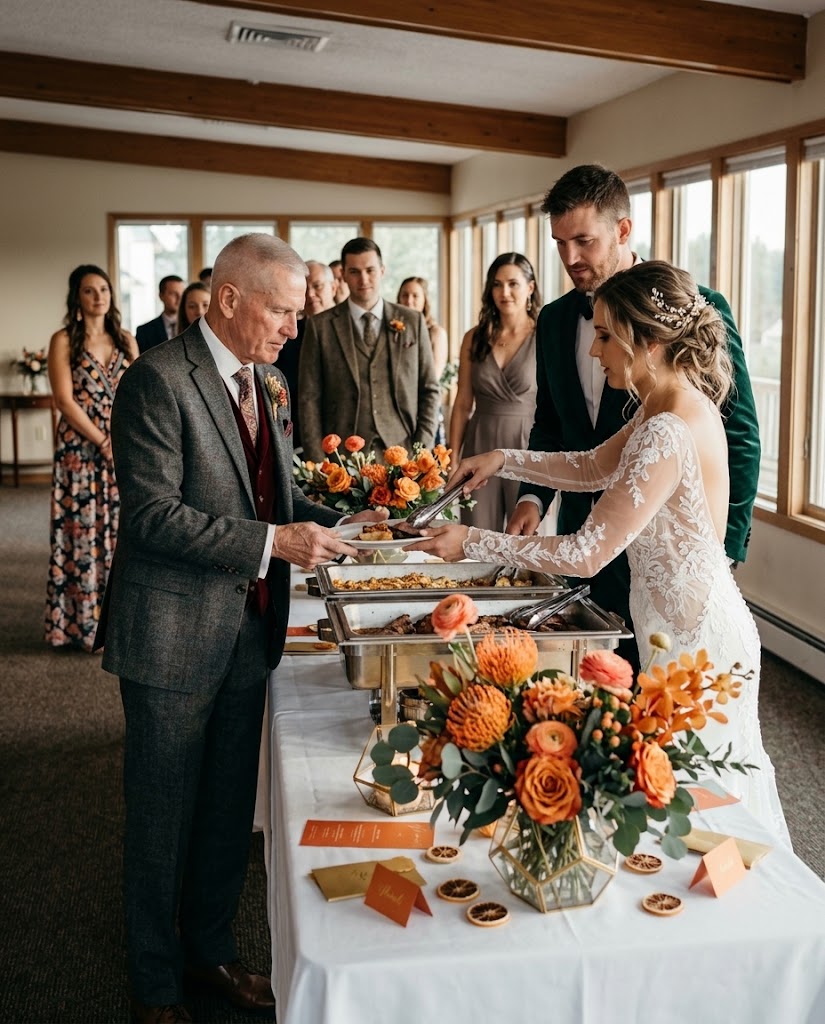
Daddy insisted on addressing the guests himself, although I had never once heard him speak before a gathering that large. We entered the sanctuary through the side door, and he stood at the front without stepping onto the platform. In a voice steadier than I expected, he explained that Derrick had decided not to attend and that the ceremony would not take place. Then he invited everyone to join us at the VFW hall, where dinner was hot, paid for, and waiting. I looked toward Derrick’s relatives, many of whom were already gathering their belongings, and added that the invitation included both sides of the aisle because none of them had done anything wrong. An elderly veteran named Harold Dawson broke the stunned silence by announcing that he had never turned down a roast beef dinner, and the laughter that followed gave people permission to stand and make their way outside. By half past five, I was at the reception hall wearing an apron over my wedding dress, serving slices of beef to the same guests who had expected to watch me exchange vows. I couldn’t bear the thought of sitting at the head table beside an empty chair while everyone studied my face, so I asked Connie, the caterer, for a serving spoon and made myself useful. People came through the line offering hugs, condolences, and memories of disappointments they had survived. Harold told me about the sweetheart who married someone else while he was serving in Korea, and the woman he later met and loved for fifty-eight years. Derrick’s Aunt Judy silently pressed my hand against her cheek, while six-year-old Emma, my flower girl, happily scattered her unused petals around the hall. Then, with sixty guests still waiting for dinner, Lorna walked through the door. She had been sitting in her car since learning that her son had abandoned me, and now she approached the buffet line with her purse hanging from one arm. The room grew quiet as she stopped across the steam table and said she wanted her mother’s ring returned immediately. I had already decided to give it back, but the demand, delivered while I stood in a wedding dress serving dinner to 140 people, hurt more than I expected. I told her she would have the ring that evening, clean and safely inside its original box, but that I would not remove it with beef gravy dripping from my hands. Then I placed two generous slices of roast beef on a clean plate and offered it to her. “There’s a seat for you at the head table,” I said. “The same one that was always going to be yours.” She hesitated, apparently expecting anger rather than an invitation. Her sister Judy, standing a few places behind her, quietly reminded her that their family was gathered in the room and that she could either sit with them or return to her car alone. After a long moment, Lorna accepted the plate, and I directed her toward the potatoes. I watched her walk away and wondered whether the day had left anything between us worth saving, or whether Derrick’s decision had destroyed another relationship besides the one we were supposed to celebrate.
When the last guest had been served, Connie insisted I sit down, and I discovered that someone had quietly removed the empty chair intended for Derrick. Grandma June sat on one side of me, Daddy on the other, and Lorna remained at the head table, carefully cutting her roast beef into pieces she barely touched. The bandleader approached and offered to cancel the music, but Grandma June had already made it clear that she intended to dance. I asked him to begin with the old Anne Murray waltz I’d chosen because my mother used to sing it while washing dishes. As the opening notes filled the hall, nobody moved toward the empty floor until Grandma June pushed back her chair, took her cane, and held out her hand to me. “I believe this is mine,” she said. I stood, and the two of us stepped onto the linoleum, one woman in her thirties wearing a wedding dress and sneakers, the other in her eighties with a cane hanging from her wrist. We couldn’t manage much more than a gentle sway, but when I apologized for the dance she’d waited so many years to have, Grandma told me she knew the difference between a hard day and a truly bad one. A bad day, she said, was a day when there was nobody left to feed and nobody willing to dance with you. Around us were 140 people who had come because they cared. I finally began to cry against her shoulder, and one by one, relatives and friends joined us on the floor. Daddy danced with Aunt Deb, Derrick’s relatives danced beside mine, and little Emma twirled through the crowd throwing the last of her flower petals into the air. Later, after Daddy had taken a turn dancing with me, I cut Aunt Deb’s cake and carried the first slice to Lorna, who was sitting alone with tears running silently down her face. She admitted that Derrick hadn’t told her he intended to disappear either. She had ironed his wedding shirt that very morning, watched him drink his coffee, and heard him promise to see her at the church. When Jeff showed her the message, she had been so ashamed and frightened that she retreated to her car. Having spent twenty-six years keeping books at a lumberyard, she reached for a pencil and calculated the expenses because numbers were the only things she could make sense of. She now understood how cruel it had been to send Tammy into my bridal room demanding repayment. I told Lorna that I remembered more about her than the envelope: the nights she’d sat with me in the hospital, the meals we’d shared, and the kindness she’d shown during the years I dated her son. I washed my hands, removed the engagement ring, wiped it carefully, and placed it in the worn green box that had held it for generations. I slid the box across the table and told her it had been a privilege to wear her mother’s ring. She covered it with her hand and wept. I did not agree to reimburse her for the rehearsal dinner or the cruise; those costs had been incurred through arrangements made by Derrick’s family, and no financial obligation had been established merely because Lorna listed them on an envelope. Had a dispute followed, it would have required examination of the relevant contracts, payment records, and any agreements actually made between us. But Lorna never pursued the demand. She stayed until the band finished at nine, and Daddy and I were the last people to leave the hall. We sat on the concrete steps in the cool night air, his charcoal suit still neat and my wedding dress marked with gravy and stray flower petals. After a long silence, he remarked that he’d attended worse weddings, and I laughed so hard I had to bend forward to catch my breath. In the months afterward, Derrick returned to town and eventually apologized, first to my father and then to me. I told him I hoped he would learn to speak difficult truths before other people paid the price for his silence. Not long after, monthly money orders for two hundred dollars began arriving at Daddy’s house, apparently intended to repay the $6,400 reception expense. We never learned who arranged them, although I suspected Lorna. Daddy signed each one over to the VFW auxiliary’s funeral dinner fund, and over thirty-two months the full amount was donated. Families throughout the county eventually shared meals paid for by money that had once been spent on a wedding that never happened.
Life did not become easy simply because I found a way to feed everyone that afternoon. I spent two weeks sleeping at Daddy’s house, cried more than once in the pharmacy stockroom, and sometimes felt a fresh ache when I passed a wedding display or heard the song that was supposed to be our first dance. I grieved the future I had imagined, not just the man who had failed to arrive. But the story that people repeated around Chanute gradually became different from the one I had feared they would tell. They remembered a bride serving roast beef in white canvas sneakers, a grandmother claiming her first wedding dance after sixty years, and a roomful of people choosing to stay together when there was no longer anything to celebrate in the usual way. Lorna and I never became mother- and daughter-in-law, yet she returned Aunt Deb’s cake stand washed and polished, with a jar of homemade pickles resting on top, and on Sundays at church she still turns around from her pew to take my hand during the greeting. We don’t discuss the $9,000 envelope or Derrick’s disappearance. There are things we have acknowledged without needing to revisit them every week. The following March, Grandma June turned eighty-five, and we celebrated at the same VFW hall. I hired the band from Parsons again, and when the white-bearded leader saw me arrive, he knew which song to play first. Grandma rose slowly from her chair, steadied herself with her cane, and held out her hand exactly as she had on that difficult afternoon. “I believe this is mine,” she said, smiling. I took her hand and led her onto the floor, where we swayed beneath the familiar streamers while relatives gathered around us. I still have the canvas sneakers I wore on the day Derrick left me standing at the church. There’s a dark stain on the left toe that no amount of scrubbing has removed, and I no longer try to get it out. Those shoes carried me through one of the hardest afternoons of my life, from a bridal room where I could barely stand to a dance floor crowded with people who refused to let me face my disappointment alone. What I remember most clearly now isn’t the empty place at the altar or the bill Lorna sent, though neither memory has disappeared. It’s Daddy standing before a silent church and inviting everyone to supper, Grandma June’s hand extended toward mine, and the unexpected sound of laughter filling a room where I had expected only pity. I never got the wedding I’d planned. But I had a dance worth remembering, and when Grandma reached for my hand again on her eighty-fifth birthday, I knew exactly where I wanted to be.

