
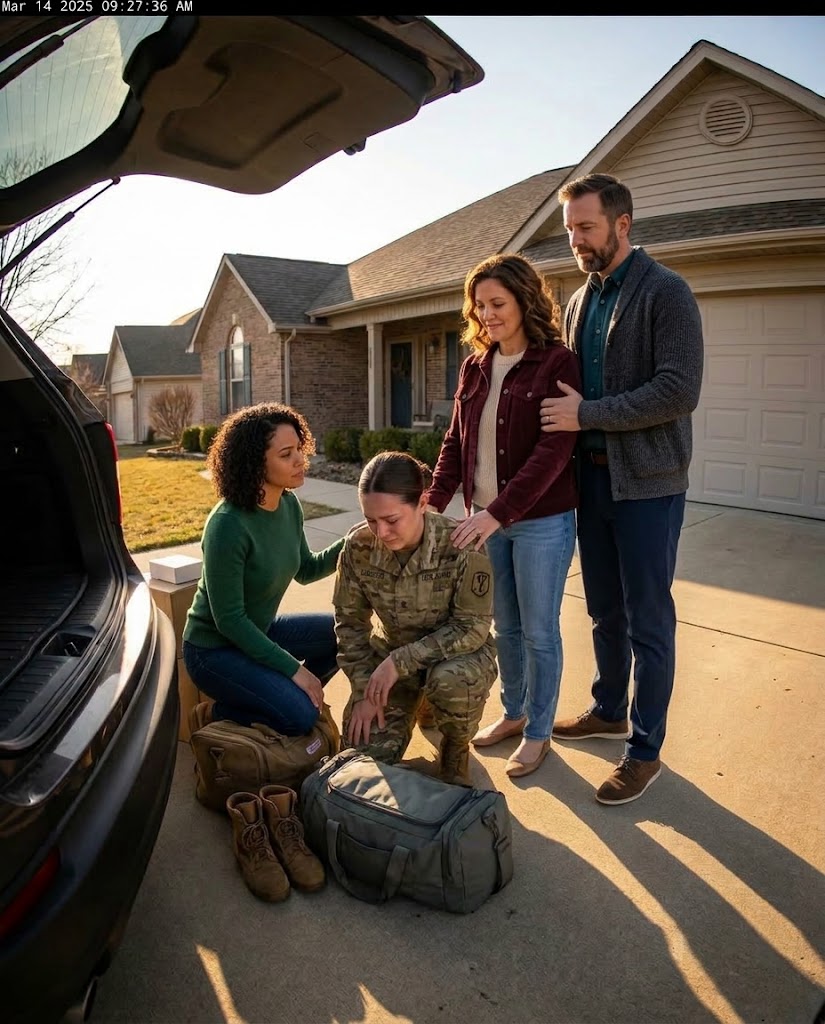
“You’re home earlier than we expected,” my mother said, standing behind eleven black trash bags lined up along my hallway wall. The house smelled of vanilla candles and unfamiliar laundry detergent, and my grandfather’s leather armchair had disappeared from its place beside the living-room window. I had been home from a nine-month Army deployment for less than five minutes, my duffel bag still hanging from one shoulder, when I found my combat boots, photographs, and clothes stuffed into plastic bags like unwanted donations. Through the open doorway, I could see a gray sectional, an enormous television, and decorative signs hanging where my bookshelves had once stood. I recognized the dent in the hallway drywall that I’d made at fourteen while carrying a bookcase upstairs with Grandpa, and the sight of it was almost painful because it proved I hadn’t somehow entered the wrong house. My father came down the stairs, surveyed the bags without embarrassment, and explained that the family had needed to make “some adjustments.” Then my mother informed me that my younger sister and her husband were living in my bedroom, while a folding cot waited for me in the unfinished basement. I said nothing, but by the following afternoon I would discover that my family hadn’t merely moved into my home while I was overseas—they had taken $45,000 from my bank accounts and were preparing documents to transfer the property out of my name.
My name is Katherine Anne Hollis, though my grandfather always called me Katie. I was thirty-one when I returned to Colorado Springs, a captain in the United States Army who had spent the previous nine months coordinating battalion logistics overseas. During deployment, I’d worked long days tracking supplies, equipment, and personnel movements, dreaming mostly of coming back to the brick house near Fort Carson that had been my one dependable refuge since childhood. My grandfather, Walter Hollis, built its porch and garage workshop himself in the 1970s and planted the pine trees that now formed a dark green boundary at the back of the property. I spent summers and holidays there, and whenever life with my parents became difficult, Grandpa made room for me without asking for explanations. He was the person who listened when I had something to say, who taught me to balance a checkbook, and who never made me feel that my accomplishments were inconveniencing someone else. When I was fourteen, I accidentally struck the hallway wall with a bookcase we were carrying upstairs. He laughed at the dent and refused to repair it, saying it gave the house another story to tell. He died when I was twenty-four, while I was attending a military training course in Georgia. A year later, the trust he’d established transferred the house into my sole ownership. The recorded deed bore only my name, and I lived there whenever I was stationed at Fort Carson. My parents knew Grandpa had left me the property, but they treated it as a family asset that I happened to occupy rather than something I legally owned. My father, Richard, was a retired Army lieutenant colonel who had served twenty-two years before accepting a civilian contract-oversight position at Fort Carson. He was proud of his military background and expected his children to obey him long after they became adults. My mother, Evelyn, had always made excuses for my younger sister, Chloe, and expected me to sacrifice whatever was necessary to make her comfortable. When Chloe broke my science-fair project as a child, I was told to forgive her because she was little. When I won a leading role in a school play, my parents missed opening night because Chloe was upset about not being cast. When I received my appointment to West Point, I was encouraged not to discuss it too much because it made her feel inadequate. Years later, I paid wedding expenses for Chloe when she and her husband, Vance, ran short of money, and my mother called those contributions gifts I should never mention again. Before my latest deployment, Evelyn offered to watch Grandpa’s house, collect the mail, and water the plants while I was away. My parents were renting a townhouse forty minutes away, and I thought giving them a key and the garage code would be a harmless convenience. Instead, they moved themselves into the house, invited Chloe and Vance to join them, and replaced my furnishings. I learned upon returning that Chloe was twenty-two weeks pregnant, something nobody had bothered to tell me while I was overseas. My mother explained that my sister needed the master bedroom because it had an adjoining bathroom. Since I was unmarried and frequently deployed, she believed I could sleep in the basement or rent a room on post. My father supported the arrangement, suggesting an Army officer should be accustomed to uncomfortable sleeping conditions. Standing among the trash bags, I recognized the familiar expectation that I would make myself smaller to accommodate Chloe. But something about the situation made me cautious rather than angry. I walked downstairs to inspect the cot they’d prepared for me, and while moving some old storage bins, I uncovered a square floor panel that was slightly lighter than the surrounding concrete. Grandpa had shown me the panel when I was sixteen. Beneath it was a steel safe bolted into the foundation, known only to the two of us. I opened it using the combination he’d taught me and found a waterproof sleeve containing the original deed, trust documents, and county recording information confirming that I was the sole owner. The papers were untouched. Then I opened my laptop and checked the bank accounts I’d barely monitored during deployment. Eleven transaction alerts were waiting in my personal email, each warning of unusually large withdrawals. The transfers had emptied my deployment-related savings and the money I’d reserved for replacing the roof. When I added them together, the total was $45,000. Every transfer led to an account I didn’t recognize, and when I reviewed the authorized agents attached to my banking profile, I found my mother’s name listed under a general power of attorney. A digital copy of the document showed a signature resembling mine, but I had never signed it. I realized somebody had used a forged authorization to obtain access to my money while I was deployed. I sat on that basement cot for a long time, listening to my family laughing upstairs in a house they believed already belonged to them, and began gathering every statement and document I could find.
Vance arrived home around six that evening, and I went upstairs to greet him and Chloe. My sister sat at the kitchen island on Grandpa’s old wooden stool, one hand resting on her pregnant belly. She looked tired and embarrassed, explaining that our mother had warned her I might be upset about the bedrooms. Evelyn quickly interrupted, assuring everyone that I understood why the changes were necessary. I told them I understood more than they realized, made myself a peanut-butter sandwich, and carried it back to the basement. I needed time to verify the evidence before making accusations that my father would immediately dismiss as emotional or ungrateful. The next afternoon, he hosted a barbecue in my backyard, inviting acquaintances from Fort Carson, including Colonel Tom Brandt, who had influence in the Army community and would later participate in reviewing my promotion record. Richard presented himself as the proud owner of a family home, telling guests that his father had left the property to everyone and exaggerating his own involvement in building the porch. I stood near the pine trees watching strangers admire a house I had been instructed to surrender without complaint. Late in the afternoon, my father motioned for me to follow him around the side of the house, away from the guests. He told me that my mother had arranged an appointment the next day with Mesa Title, where I was expected to sign a quitclaim deed transferring ownership to Chloe and Vance. His explanation was that they needed stability for their growing family, while I was single and frequently absent. When I reminded him that Grandpa had left the property solely to me, he accused his father of favoritism and said the house should have been his inheritance. Then I asked why my mother couldn’t sign the deed on my behalf if she possessed a valid power of attorney. For a moment, his expression went blank. He recovered by claiming the title company required my signature because I was a deployed service member, which told me they’d already tried to transfer the property without consulting me and had encountered an obstacle. I asked what would happen if I refused. Richard lowered his voice and reminded me that my promotion to major was approaching and that he knew people who might be concerned by reports of financial irregularities involving an Army officer. He mentioned security clearances and professional judgment, making it clear that he was prepared to use the very financial problems my family had created to threaten my career. I replied that I would ensure the paperwork was handled correctly, and he returned to the barbecue believing I had agreed. The next morning, I took the original deed, bank statements, and forged power of attorney to the legal-assistance office at Fort Carson. Captain Elena Morales reviewed the documents and immediately recognized the seriousness of an unauthorized financial agent gaining control of a deployed officer’s accounts. She referred me to Martin Dalton, a civilian attorney experienced in property and estate matters, who examined the trust documents and verified that the house had passed legally into my sole ownership years earlier. Neither parent had ever held title. While reviewing the old folder from Grandpa’s safe, Dalton found a concealed pocket sewn into its back cover. Inside was a sealed envelope addressed in my grandfather’s handwriting: “For Katie. Only if.” The letter was dated years before his death and explained something I had never known. In 2011, my father had forged Walter’s signature on a $60,000 loan secured against the house. Grandpa discovered the unauthorized borrowing after receiving delinquency notices, paid off the debt himself, and chose not to report his son to the police. But he had documented the incident in a notarized affidavit, preserving details of the lender, the loan, and the signature that had been used without his permission. He placed the affidavit and supporting copies in the hidden envelope because he feared Richard might eventually attempt another fraud. Grandpa wrote that he had left me the property not because I was loved more than anyone else, but because he trusted me to care for it and believed I might someday need a secure place beyond my parents’ control. At the bottom of the letter, he asked me to stop making myself smaller for other people and to be good to myself. Reading those words, I finally understood why he’d shown me the safe when I was sixteen. Dalton compared the old loan document with the recently uploaded power of attorney and noted similarities between the suspect signatures that warranted professional examination. The evidence suggested a possible pattern of forgery spanning many years. Then he telephoned Mesa Title and learned that Evelyn had indeed tried to arrange a transfer while I was overseas, but the company had refused to proceed without additional verification and my direct authorization. The next appointment was scheduled for two o’clock that afternoon. Rather than appearing alone to sign away my home, I decided to keep that appointment with legal counsel and the authorities informed. My parents still believed I was coming to make Chloe a homeowner, but the documents Grandpa had hidden beneath the basement floor were about to reveal what they had tried to conceal.
At 1:55 that afternoon, I heard vehicles entering the driveway while I sat in the basement wearing my Army uniform, Grandpa’s letter folded carefully in my breast pocket. Upstairs, my mother had arranged a plate of cookies and a bottle of champagne tied with a red bow. A card beside it congratulated the new homeowners, although the deed remained in my name and I had never agreed to transfer it. Chloe was reclining on the gray sectional, Vance stood near the kitchen, and my father waited at the door with the confident expression he wore whenever he believed he controlled a situation. When the bell rang, he opened it to find Martin Dalton, Captain Morales, officers from the Colorado Springs Police Department, and an investigator associated with the Army’s criminal-investigation service. Richard immediately announced that it was a private family matter. I stepped forward and said it was my house and that I was inviting the visitors inside. Dalton presented the ownership documents, while investigators explained that my bank records showed $45,000 in transfers linked to an apparently forged power of attorney naming Evelyn as my financial agent. My mother insisted I had signed the document before deploying, but I told her plainly that I had never authorized her to withdraw money from my accounts. Captain Morales showed the suspicious signature beside examples of my genuine handwriting, and Dalton explained that Grandpa’s sworn affidavit described an earlier unauthorized loan involving my father and the same property. Richard appeared shaken when he learned that his own father had documented the 2011 incident. He had assumed the matter was forgotten after Walter repaid the debt. The investigator also raised the threat Richard had made about interfering with my promotion, explaining that Colonel Brandt had reported troubling comments from the barbecue about alleged financial problems affecting my military record. My father tried to describe the dispute as a misunderstanding caused by my recent deployment, but the investigators focused on the records rather than his explanations. Chloe listened in disbelief as my mother admitted that the money had been used to help pay household expenses, including debts belonging to Chloe and Vance. She had been told I wanted to support their pregnancy and planned to give them the house. Chloe turned to me and asked whether I’d known she was expecting a child. When I said I’d learned about the pregnancy only after arriving home, she began crying. Vance admitted he had known some of their bills were being paid with money from my accounts, though he claimed Evelyn had assured him I had arranged it voluntarily before leaving overseas. He acknowledged that he’d accepted the help without asking me directly. Investigators asked my parents to accompany them for formal statements and advised them about obtaining legal representation. There were no dramatic handcuffs in the living room, only an uncomfortable silence as the truth settled over everyone. On the porch, my mother turned back and asked how I could do such a thing to my family. I thought about the trash bags, the forged signature, the basement cot, and the money earned while serving overseas. I told her I hadn’t created the problem; I had simply stopped hiding its consequences. After my parents left, Chloe remained in the living room, looking around at the furnishings she’d believed were part of her new home. She apologized for accepting our mother’s explanation without questioning it and admitted she’d spent much of her life feeling jealous of my achievements. Evelyn had encouraged her to believe I had always received more than she did and that giving her the house would correct an old injustice. For the first time, Chloe recognized how much of that story had come from our parents. I asked about Grandpa’s leather armchair, and Vance explained that he’d moved it into the garage workshop rather than allowing Evelyn to discard it. The gesture was small, but I appreciated that he’d protected something important to me when others hadn’t. Over the following weeks, Chloe and Vance found a modest two-bedroom apartment on the east side of Colorado Springs. They moved voluntarily, acknowledging that the property wasn’t theirs and that I needed my home back. Vance found work with another construction crew, and I helped them move because I wanted to rebuild a relationship with my sister on honest terms rather than continue the old pattern of resentment and obligation. The investigation lasted several months. Authorities reviewed the electronic bank records, the disputed power of attorney, testimony from Mesa Title, my grandfather’s affidavit, and the communications surrounding the proposed property transfer. My mother faced charges involving theft and forgery, while my father faced forgery-related allegations and consequences connected to his attempt to interfere with my military career. In December, they accepted plea agreements resulting in probation, criminal records, and restitution of the $45,000 through scheduled payments. Richard also lost his civilian position on post following the investigation into his conduct. I didn’t feel triumphant when I learned they had sold their car to make the first repayment. I felt tired, disappointed, and relieved that the financial damage was finally being addressed. My parents withdrew from contact with me, though my father called once after reading the affidavit in his attorney’s file. He sounded shaken to discover that Grandpa had never forgotten the original fraud. I told him Walter had chosen to forgive him but had also chosen to protect others from a repetition. We haven’t spoken since that conversation. In January, Chloe gave birth during a snowstorm. Vance called at four in the morning and said she wanted me at the hospital if I was willing to come. I arrived to find my sister holding a tiny girl wrapped in a striped blanket, her cheeks red and her fists curled beneath her chin. They named her Wren, with Walter as a middle name in honor of the grandfather we’d both loved. Chloe asked whether I wanted to hold her, and I took my niece carefully into my arms, astonished by how much warmth such a small person could carry. I knew immediately that I wanted to be for Wren what Grandpa had been for me: the adult who asked what she thought, listened to her answer, and never expected her to earn love by surrendering something important. In March, the Army promotion list was released, and I received confirmation that I’d been selected for major. Colonel Brandt sent a note congratulating me and assuring me that my record had been considered on its merits. That mattered more than I expected after the threats my father had made. By April, I finally began unpacking the eleven trash bags that had remained in the hallway since my return. I repainted the master bedroom, put my books back on the shelves, rehung my photographs, and retrieved Grandpa’s leather chair from the garage. Vance had covered it carefully to protect it from dust. I carried it into the living room and placed it beside the front window, where it had stood for decades. The gray sectional, enormous television, and decorative signs were gone. The room looked like itself again, and for the first time since coming home, I felt the full weight of what I’d nearly lost.
A little over a year after returning from deployment, I can sit in Grandpa’s chair and look through the living-room window at the pine trees he planted when I was a child. The roof has been replaced, the porch railing is secure, and my combat boots stand beside the front door instead of lying in a trash bag. Chloe, Vance, and Wren come over most Sundays, and our dinners have become a familiar part of the week. We eat at Grandpa’s old table, which Vance repaired after discovering a loose leg, and afterward my sister and I sit on the porch while her husband washes the dishes. Wren often sleeps in a bassinet between our chairs, making those small, uncertain sounds newborns make before they settle. Our relationship is still complicated. Chloe and I spent years hearing different stories about one another, and sometimes an innocent comment brings back an old hurt neither of us has fully understood. We stop, explain what we meant, and try again. I no longer believe the only way to be a good sister is to absorb whatever my family needs without asking questions. Chloe no longer assumes that my achievements mean I’ve had an easier life than hers. We are learning to see one another as adults rather than the roles our parents assigned us. Vance has become more dependable too, taking responsibility for his family’s expenses and offering practical help without expecting ownership or repayment. Last autumn, he and I worked together over three weekends to replace the old roof I’d originally intended to repair with my deployment savings. He knew considerably more about roofing than I did, but I kept the project organized and made sure we had the materials we needed. We made a good team, even when we disagreed about the proper way to measure or cut something. My parents remain distant. Their restitution payments continue, though the money no longer feels like the center of what happened. The greater loss was discovering that the people I had trusted to care for my home were willing to take advantage of my absence and then use their authority as parents to make me feel guilty for objecting. Some days I still wonder whether I could have prevented any of it by refusing to give my mother a key. Other days I remember that a person should be able to trust family members with a house key without fearing forgery or financial theft. I no longer spend much time searching for an explanation that will make their decisions reasonable. What I know is that Grandpa understood the danger long before I did. He’d seen his son forge a signature, paid the debt, documented the facts, and quietly arranged his estate so I would have somewhere secure to live. I wish he’d never needed to take those precautions, and I wish he’d been alive when I found the letter. I would have wanted to ask why he waited so long to tell me the truth, and whether he knew how often I’d tried to be the daughter and sister everyone expected. Perhaps he would have reminded me of the summer my parents went away with Chloe and left me in his care. We sat on the porch drinking root beer, and he observed that I rarely asked for anything, while Chloe asked for everything. He told me that being quiet might help avoid an argument, but it wouldn’t always protect me from people who were willing to take advantage of my silence. I was fifteen then and thought he was teasing. I understand him better now. I keep his letter in my nightstand beside a photograph of the two of us on that same porch, squinting into the summer sun. Sometimes I read it after a difficult day, particularly the part where he asks me not to make myself smaller in his house. Those words helped me challenge years of habits that had seemed impossible to change. They also remind me that I can be generous without giving other people unlimited control over my life. I still help Chloe when I can, but now we talk openly about what assistance means, what is affordable, and where the responsibility belongs. I have begun setting aside savings again, including money for future repairs and for the security I want in my own life. I’ve returned to my Army duties with a stronger sense that my professional record and personal independence are things worth protecting. I enjoy the ordinary comfort of coming home after work, unlocking my own front door, and seeing familiar furniture rather than wondering whether someone has rearranged my life in my absence. Wren is growing quickly, beginning to recognize my voice and reach toward me when I visit. I tell her stories about Grandpa while we sit beneath the pine trees, and one day I’ll show her how to balance a checkbook, just as he showed me. Recently, I went down to the basement and opened the safe beneath its concealed floor panel. The deed and original trust documents were still inside their waterproof sleeve. I had written a letter of my own, addressed to Wren, to be opened only if she ever needed advice or reassurance about standing up for herself. I placed it beside the documents, hoping she’d never face anything like what happened to me. Then I closed the safe, returned the panel to its place, and went upstairs. The late-afternoon sun was shining across Grandpa’s leather armchair, warming the worn surface where he’d rested his hands for so many years. I sat down and listened to the quiet of the house, not an empty silence but the familiar stillness of a place where I belonged. My family had tried to convince me that being a good daughter and sister meant surrendering the things Grandpa left me. I had finally learned that loving people didn’t require agreeing to be displaced by them. The boots beside the door were mine, the name on the deed was mine, and the home I’d returned to after nine months overseas was once again a place where I could rest without having to ask permission.

