
“Sell us the house back for a dollar,” my mother said, sitting at my kitchen table with her coat still on and her purse hooked over her arm. Outside, the March wind rattled the storm windows, and the furnace hummed beneath the floorboards as my father slowly turned his seed cap in his hands. My husband, Dale, sat beside me in his barn socks, his hair still damp from the shower he’d taken after finishing chores. Mom explained that my divorced brother and his three children were sleeping on air mattresses in my parents’ basement, and she wanted us to surrender the farmhouse so they could have a proper home. I looked toward the doorway, remembering the freezing winters, the dangerous wiring, the roof that had nearly collapsed, and every dollar we’d spent making the place livable. My parents had indeed sold me the house for one dollar twenty years earlier, but Dale and I had since invested $60,340 in repairs, not counting thousands of hours of our own labor. Under the table, my husband’s hand found my knee and squeezed it once. Instead of arguing, I thanked my parents for coming directly to me and promised them an answer by Saturday, although I already knew I couldn’t give them what they wanted.
My name is Tammy Rensink, and I was forty-six that spring, working as a rural mail carrier in Sheldon, Iowa, where I’d delivered mail for nineteen years. Our white two-story farmhouse stood four miles outside town, sheltered from the north wind by a row of cedars. My great-grandfather Kirchner built it in 1912, and three generations of our family had grown up inside its walls. In 2005, my parents retired from farming, sold the cows, rented out the surrounding land, and moved into a smaller house in town. The farmhouse sat empty until I married Dale the following year. Dad offered to sell us the house and two acres for one dollar, partly because he wanted us nearby and partly because the old place needed more work than he could manage. We completed the property transfer, with the difference between the nominal purchase price and its fair market value treated as a gift for tax purposes. Dad folded the dollar bill I’d handed him at closing and declared the house paid in full. But ownership was only the beginning. Our first winter, Dale and I wore stocking caps to bed because the oil furnace couldn’t heat the upstairs bedrooms. In 2009, an electrician discovered hazardous old wiring that cost $11,500 to replace. A hailstorm later exposed rotten roof decking, leaving us to pay $14,000 beyond what our insurance covered. When the furnace finally failed, we installed a propane system and new ductwork for $7,800. Then came the well pump, septic system, windows, porch, and water heaters. I recorded every expense in a spiral notebook kept in the kitchen hutch. By the time my parents asked for the house back, the total reached $60,340, and that didn’t include the work we’d done ourselves. We’d raised our daughter Hannah there, rebuilt rooms with our own hands, and turned a deteriorating farmhouse into our family’s home. Meanwhile, my younger brother Jeff, forty-three, had always been the child my parents rushed to rescue. When his marriage collapsed that January, his wife, Amber, moved to Sioux Falls, leaving him with their three children: twelve-year-old Brody, nine-year-old Kenzie, and six-year-old Cole. Their rented house was being sold, and by February they were living in my parents’ basement beside the chest freezer and Dad’s deer mounts. I worried about them constantly. Cole had begun wetting the bed, and Kenzie cried where she thought nobody could hear. But after Mom and Dad left that Tuesday evening, Dale reminded me that the house belonged to both of us in every way that mattered. He’d repaired it, worked for it, and built his life there too. He wouldn’t willingly surrender it. I agreed. Still, lying awake that night, I couldn’t stop thinking about the children sleeping in the basement. By three in the morning, I realized we had two unused bedrooms upstairs, along with a bathroom. They were crowded with Christmas decorations, old furniture, and boxes, but they could become bedrooms again. By sunrise, I’d made my decision. I wouldn’t give away our house, but I would open its doors.
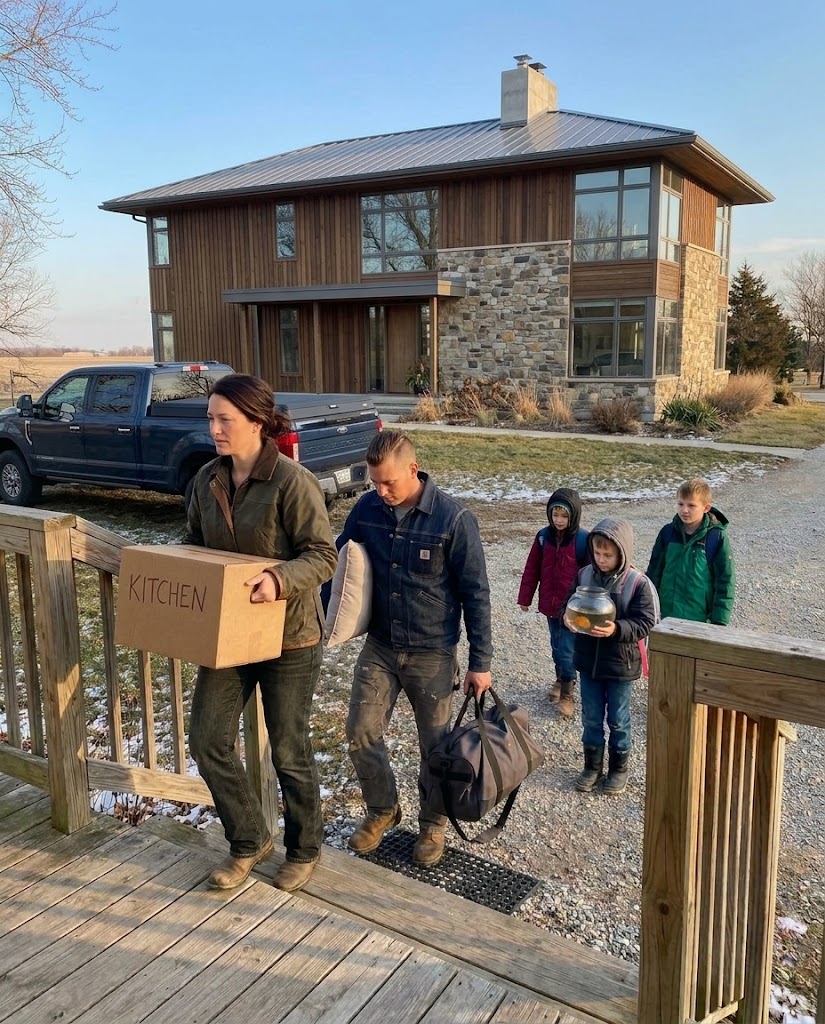
The next morning, I telephoned Jeff from my mail route and told him Dale and I wanted him and the children to move into our upstairs rooms that Saturday. He tried to refuse, worried that four additional people would overwhelm our household, but I reminded him that Dale raised hogs and we had plenty of food. On Saturday morning, Hannah helped clean the bedrooms while Dale moved furniture and carried boxes to the machine shed. We put bunk beds in one room, made a place for Jeff in another, and gave Kenzie the little room beneath the eaves where I’d slept as a child. When Jeff’s pickup arrived with a mattress tied in the bed and garbage bags full of clothes, he stood looking at the farmhouse as though he wasn’t certain he deserved to enter it. Brody carried his backpack inside, Kenzie examined the pink curtain I’d hung, and Cole carefully transported a goldfish named Pickles, asking whether the fish could have his own room. That evening, seven of us crowded around a table built for six. Brody devoured three sloppy joes, Hannah began braiding Kenzie’s hair, and Cole laughed when Dale described the expensive furnace as costing more than a lot of hogs. After everyone went to bed, Jeff came downstairs holding our mother’s old wooden yardstick. He’d found it in Kenzie’s closet, beside the pencil marks on the doorframe where Mom had recorded our heights every summer. I’d protected those markings through every renovation, carefully painting around them. Jeff traced the line beside his name from 1988, when he was five. Then he fetched a sleepy Cole, stood him barefoot against the same frame, and made a new mark: COLE 6 — 2026. His voice broke when he realized his son was already taller than he’d been at that age. The following day, Mom and Dad arrived for Sunday dinner. For a while, everything seemed peaceful, until Mom announced that once the property papers were signed, Jeff could renovate the farmhouse however he pleased. Jeff stopped eating and asked what papers she meant. Mom explained that she and Dad had asked me to transfer the house back to them for a dollar so they could give it to him. I told her I had never agreed. Jeff looked stunned, then furious. He said he hadn’t asked for my house and wouldn’t accept it, particularly after seeing everything Dale and I had done to help his family. Mom protested that Jeff had nothing while I had a husband, stable work, and a farm, insisting that I’d always managed to land on my feet. Jeff answered that our parents were trying to solve his problems by taking away something his sister had spent twenty years rebuilding. He reminded them of the repairs, the money, and the years we’d endured freezing rooms and unfinished projects. Dad finally asked why I hadn’t simply refused their request. I told him I’d wanted to say no from the beginning, but I couldn’t bear watching Jeff’s children struggle. Offering them the upstairs rooms was the only answer that protected both households. Then Cole interrupted, proudly announcing that Daddy had measured him against Grandma’s old doorframe and that he’d already surpassed his father’s childhood height. Mom learned that all her measurements were still there, preserved beneath decades of paint, with a new generation’s name added beside them. She covered her face and began crying. The house she’d asked me to surrender wasn’t merely a gift my parents had once made; it had become the place where her grandchildren could find their footing without anyone losing their own home.
Jeff and the children stayed with us through the spring and summer, turning our quiet farmhouse into a crowded, noisy household. We agreed that he’d contribute $400 a month toward groceries and propane and save the rest of his wages for a permanent home. It wasn’t a complicated arrangement, but it gave everyone clear expectations and kept us from confusing temporary help with a transfer of ownership. Jeff worked long hours at the agricultural cooperative, sometimes operating equipment for fourteen hours during planting season. He came home tired but still read bedtime stories to Cole. Brody began helping Dale with age-appropriate chores around the hog barns, earning ten dollars a day and learning how much attention the animals required. Hannah taught Kenzie to braid hair, and by May my niece could make a French braid without looking in a mirror. Cole explored the farmyard, named the barn cats after different kinds of pie, and somehow kept Pickles alive through the commotion. There were mornings when the hot water ran out and evenings when I longed for an empty kitchen, but I also watched the children gradually relax. They were sleeping in real beds, attending school, and beginning to believe that their lives could settle again. My mother started visiting every Wednesday, usually carrying a casserole or coffee cake. She helped the children with homework and taught Hannah to make pie crust the way her own mother had. She didn’t mention the house again. One afternoon, I came home from my route and found her standing alone upstairs with her hand resting against the old growth marks. I left her there and went downstairs to make coffee. In August, a small house a mile and a half down our gravel road came on the market for $138,000. It had a detached garage, a garden, and two lilac bushes near the back door. Jeff had saved $9,400 since moving in with us. He reviewed the asking price, his savings, the anticipated closing costs, and a conventional mortgage with a down payment of slightly more than five percent. Dale helped him inspect the property’s major systems, while Jeff worked through the lender’s approval process. In October, he closed on the house using his own money. The children moved into bedrooms that belonged to their family, and Jeff could finally unpack without wondering when they’d have to leave again. The next morning, Dad drove out to see me alone. Standing at my kitchen table with his seed cap in his hands, he opened his worn wallet and removed a dollar bill folded into quarters. It was the same bill I’d given him at our closing twenty years earlier. He told me he’d carried it ever since, showing it proudly to friends as the dollar he’d accepted for the old home place. Then he admitted he’d never considered what Dale and I had spent after taking ownership. He’d remembered the gift but overlooked the repairs, the sacrifices, and the life we’d built there. His voice grew rough as he apologized for asking me to give it away. I told him I’d forgiven him, though I hadn’t been willing to surrender the house. He pushed the dollar across the table and told me to keep it because I’d paid more for the place than anyone. I tucked it inside the spiral notebook with the receipts. That night, Dale and I lay awake listening to the furnace and the wind moving through the cedars. The house was quiet again, just as we’d wanted. After months of children arguing over bunk beds and footsteps on the stairs, we discovered we missed the noise.
The following morning, I went upstairs to Kenzie’s old room and opened the closet door. The markings from my childhood were still there, along with the new line Jeff had drawn for Cole. I rested my fingers beside it and thought about the spring when our family had nearly divided over a house that my parents once sold for a dollar. The deed had made Dale and me responsible for the property, but the twenty years we’d spent repairing it had made the place ours in a deeper, more personal way. Helping Jeff had never required us to surrender that. He and his children now lived only a short drive away, and the farmhouse remained the place where they gathered for Sunday dinners and birthdays. I kept thinking about Cole asking whether being taller than his father had been at six was a good thing, and Jeff answering through tears that it was. Before I left the room, I fetched a roll of blue painter’s tape from the kitchen drawer and set it on the windowsill. We’d need it the next time we painted. There was plenty of doorframe left, and I intended to keep every new mark.

