
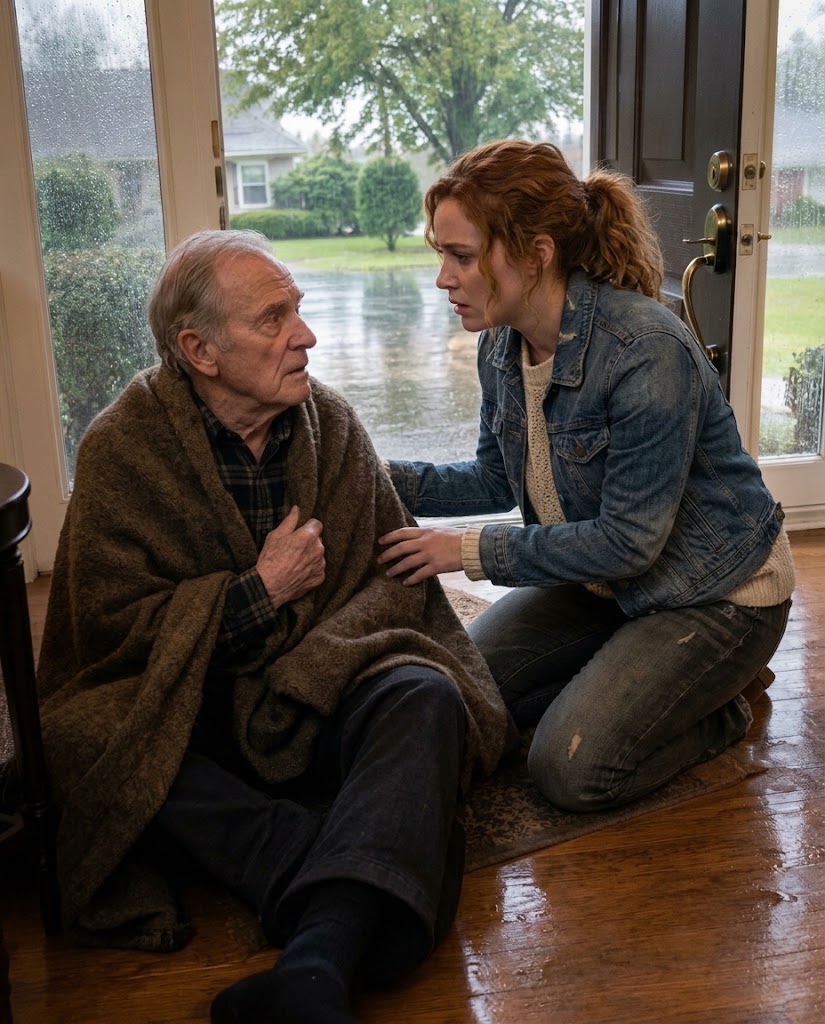
The house was so cold I could see my breath when I opened the front door, and the smell from the living room stopped me in my tracks. I had just driven three hours through sleet and icy roads, carrying Thanksgiving groceries and imagining my husband waiting to welcome me home after six months of military training. Instead, the lights were off, the thermostat read fifty-two degrees, and a handwritten note lay beside a bowl of rotting fruit on the kitchen counter. Mom and I went on a cruise. You take care of Victor. Back Monday. I dropped the grocery bags and hurried into the living room, where seventy-two-year-old Victor Harmon sat trembling beneath a thin blanket, his clothes soiled and his lips cracked from dehydration. He was dying of pancreatic cancer, too weak to walk to the bathroom or reach the kitchen without assistance, and the people responsible for his care had left him alone. When I knelt beside him, he opened his eyes, recognized me, and whispered something I would never forget: “They don’t know about the money, Jenna. There’s something I need you to help me do.”
My name is Jenna Mitchell, and at thirty-two, I was an Army sergeant who had spent much of the previous six months away from home. I’d been counting the days until Thanksgiving, picturing a turkey in the oven, a glass of wine after dinner, and a quiet weekend with my husband, Brady. We’d been married five years. He worked in real estate, or at least that was how he described his profession, while my steady military income covered most of our household expenses. I had never minded contributing more financially because I believed marriage meant supporting one another through different circumstances. Brady’s mother, Elaine, had married Victor several years earlier. Victor was a retired bank manager and former Marine who had served in Vietnam, a proud man with a dry sense of humor and an old-fashioned habit of standing whenever someone entered a room. Even when his cancer progressed, he tried to maintain his independence. He had always treated me kindly, asking about my training and listening with genuine interest when I spoke about my work. Over the past year, however, chemotherapy and advancing pancreatic cancer had left him increasingly frail. By Thanksgiving, he required regular assistance with personal care, medication, and meals. I’d understood that Elaine and Brady were coordinating his care while I was away. Nothing had prepared me to find him alone in an unheated house, unable to manage his most basic needs. I called for medical help and contacted his hospice care team, explaining the conditions I’d discovered and my concerns about missed medication, dehydration, and possible neglect. While waiting for assistance, I raised the temperature, covered Victor with clean blankets, and stayed beside him, offering small sips of water only after checking that he could swallow safely. He was ashamed of needing help, and I assured him that he had nothing to apologize for. His condition required proper assessment and symptom management, not improvised treatment from someone who had merely learned emergency care during military training. I preserved Brady’s note and photographed the thermostat and the condition of the room without asking Victor to endure further discomfort. Once the medical team had assessed him and arranged appropriate comfort measures, I began looking for an explanation. The family tablet displayed a vacation notification, and a photograph appeared showing Brady aboard a cruise ship with a young blonde woman named Hannah. His arm was around her waist, and she had described him as her “sugar daddy.” My stomach dropped. I checked the transactions on our joint account through my own banking access and discovered that the available balance was just $12.45. Recent charges included $4,850 for the cruise, $600 for a drinks package, $5,200 withdrawn at a casino, and expensive purchases from luxury retailers. The money we’d been saving for repairs to our roof had apparently financed the vacation instead. Months earlier, Brady had told me a contractor needed a $6,000 deposit to address serious water damage near the chimney. I’d transferred the money from my savings because I trusted him. Now I couldn’t find evidence that the work had been scheduled. I sat at the kitchen table staring at the transaction history, struggling to absorb the possibility that my husband had lied about the house, drained our shared savings, and abandoned his critically ill stepfather while traveling with another woman. Yet there was someone in the living room whose immediate needs mattered more than my anger, so I put the tablet aside and returned to Victor.
After the medical team helped make Victor comfortable, he asked me to sit beside him. His voice was weak, but his mind seemed clear, and he wanted me to listen carefully. Elaine, he explained, had been resentful of the demands of his illness for months. He said she’d complained about the expense of his care and occasionally spoken about him as though he were a financial burden. He pointed toward an empty patch of wallpaper above the fireplace, where his framed military decorations had once hung. According to Victor, Elaine had sold the medals without his consent for approximately $500. I remembered the display vividly: the Bronze Star, Purple Heart, service ribbons, and photographs from a younger man’s life. Seeing the wall bare seemed to trouble him almost as much as the neglect he’d experienced. He was also concerned that his prescribed pain medication hadn’t been administered properly. One bottle appeared inconsistent with what he expected, so I set it aside and asked the clinicians to review his medications rather than attempting to identify or administer an unfamiliar liquid myself. Victor told me he believed Elaine had been withholding treatment to save money. That allegation was too serious to dismiss or to declare proven without evidence, and I made sure the medical team knew what he’d said. Then he reached for my hand and revealed the secret he’d hinted at when I arrived. Before his marriage to Elaine, he had established a revocable living trust containing investments accumulated during his banking career and proceeds from the sale of his former home in Virginia. Elaine knew about the checking account that received his pension, but she had never been told about the larger investment portfolio. Victor estimated its value at more than $3 million. He explained that he had kept the assets separately managed because he’d become concerned about Elaine’s spending habits and wanted his savings protected. He had once planned to provide generously for her and Brady after his death, believing they would care for him when his health failed. Now he wanted to review those arrangements. He asked me to contact his attorney, Patricia Caldwell, and told me he wanted his estate to reflect the people and causes he still trusted. I was stunned, not merely by the amount of money but by the fact that a man sitting in a room without adequate heat had access to substantial assets his wife apparently knew nothing about. I told him we needed to concentrate on his comfort first and allow Patricia to explain what he could lawfully change. Victor nodded. He wasn’t asking me to take the money or sign anything on his behalf; he wanted to make his own decisions while he was still able. The next morning, Patricia arrived with his estate-planning documents and confirmed that the trust held a diversified investment portfolio valued at approximately $3.25 million. Its existing provisions included substantial benefits for Elaine and Brady. Victor instructed her to prepare changes naming me as a principal beneficiary and directing a significant portion of the assets to charitable work supporting injured veterans. Patricia explained that any amendment would have to comply with the trust documents and applicable law, and that Victor’s legal capacity, freedom from undue influence, and understanding of the consequences were essential, particularly because of his advanced illness. She arranged for the necessary independent assessment and execution formalities, while making clear that she represented Victor’s interests rather than mine. As she reviewed the papers, I sent Brady a message explaining that Victor had been found in a dangerous condition, was receiving medical attention, and needed his family. Brady replied that they had paid for the cruise and couldn’t keep interrupting their holiday whenever Victor had a bad day. He told me to handle the situation until Monday. I showed Victor the reply because he’d asked whether his family intended to return. He read it without speaking for a long time. Then he looked at Patricia and quietly repeated his instructions: whatever happened to the money, he wanted the final decisions to belong to him.
Patricia spent the afternoon reviewing Victor’s intentions, the existing trust provisions, his medical condition, and the potential for future disputes. She explained that a revocable trust could generally be amended by its settlor while he retained the required legal capacity, but that spousal property rights, beneficiary designations outside the trust, and the terms of any previous agreements also needed careful consideration. Victor understood that disinheriting family members could prompt litigation, particularly when significant changes occurred near the end of life. He nevertheless said his wishes had changed because of the treatment he’d received and because he wanted his estate used in ways that reflected his values. Patricia documented his instructions and arranged for legally appropriate witnesses and execution procedures. I deliberately stepped away from any role that might make it appear I was directing his decisions for my own benefit. The possibility of inheriting a fortune felt distant compared with the reality of the man struggling to breathe in front of me. I also began dealing with the damage Brady had done to our marriage. I downloaded the transaction history available from our joint account, contacted the financial institution to discuss protecting my remaining income and identifying any transactions that might have been unauthorized, and arranged to speak with a family-law attorney about separation, marital debt, and the treatment of funds withdrawn from jointly held accounts. I knew that spending money irresponsibly wasn’t automatically the same as criminal theft, especially where an account holder had access to the funds, but the records would matter if I decided to pursue divorce or seek an accounting of marital assets. I also preserved the messages and vacation photographs rather than confronting Brady through social media. What concerned me most urgently was Victor’s care. The clinicians arranged medication management and continued support, while I reported the circumstances in which I’d found him to the appropriate adult protective services authorities so the concerns about neglect could be investigated. Our neighbor, Mrs. Fletcher, told me she’d seen Brady leaving with Hannah and had noticed the house remained dark afterward. I asked her to provide that information directly to investigators if contacted. I didn’t need to turn every painful detail into a public spectacle; I needed an accurate record of what had happened. Later that evening, Victor asked whether Elaine had called. She hadn’t. At his request, I tried once more to reach the family so they could speak with him while he was still conscious. When the call connected, music and laughter filled the background. Elaine sounded irritated that the vacation was being interrupted, and Brady insisted that he would deal with matters when he returned. I explained that Victor was critically ill, and the medical team believed he might have little time remaining. Neither promised to return immediately. I ended the call and sat quietly beside him. I won’t pretend he was unmoved. He turned his face toward the window, and a tear ran down his cheek. Patricia had completed the estate documents according to the arrangements she considered necessary, and Victor had expressed his final intentions in his own words. But legal documents couldn’t soften the knowledge that the people he’d expected to be there were somewhere else. As the evening grew darker, his breathing became increasingly irregular. The hospice nurse explained the changes and helped keep him comfortable. When Victor asked for peaches, remembering the cobbler his mother had made when he was a boy, I warmed a little canned fruit with cinnamon and brought it to him. With the nurse’s guidance, I offered him a small taste while he was alert enough to manage it. He smiled faintly and whispered that it was good. Later, he struggled to remove the Marine Corps signet ring he’d worn for decades. I helped slide it from his finger, and he pressed it into my palm. He told me he’d always considered me a daughter, not merely the wife of his stepson. I began to cry and told him I was honored he’d trusted me. He looked at me for a moment and said, “At ease, Sergeant.” It was the last thing he said clearly. I stayed beside him through the night, holding his hand while the nurse monitored his comfort. Shortly before dawn, Victor died peacefully. The medical team confirmed his death and helped me with the necessary arrangements. I had expected Thanksgiving to end with a full table, a roasted turkey, and the familiar noise of family conversation. Instead, I found myself sitting in the quiet living room, holding the ring of a man who had been abandoned when he needed kindness most. I had no desire to turn his death into a performance of revenge. There would be time to address the legal consequences of the neglect allegations, the missing savings, and the changes to his estate. For the moment, I wanted him treated with the dignity he’d been denied.
Brady and Elaine were still away when I began notifying the people who needed to know Victor had died. Patricia arranged for the original estate-planning documents to be secured and explained the next steps for administering the trust and any probate estate, subject to verification of their validity and the rights of anyone with a lawful claim. I understood there could be challenges ahead. Elaine might contest the changes, Brady might dispute how our savings had been spent, and authorities would have to decide what the evidence established about Victor’s treatment. I couldn’t predict the outcome of any of those matters, and I didn’t need to settle them before allowing myself to grieve. What I knew was that Victor had wanted to decide what happened to the wealth he’d spent a lifetime building, and that he’d sought professional help to make those wishes known. The investment portfolio might eventually support people and causes he valued, including veterans who needed assistance rebuilding their lives. But the thing I carried most carefully that morning wasn’t a financial document or an account statement. It was his ring, warm from my hand, and the memory of the way his expression softened when he tasted the peaches. I thought about the Marine who had once commanded others, the bank manager who had spent decades working, and the elderly man who had tried so hard not to feel embarrassed by his illness. None of those parts of his life had disappeared simply because he needed help. As the first pale light appeared beyond the curtains, I folded the clean blanket over the empty chair and went into the kitchen. The Thanksgiving groceries still sat where I’d left them. I put the food away, washed the dishes, and made a cup of coffee. When I finally sat down, the house was warm. Victor had not been alone at the end, and whatever came next, I was grateful I’d made it home in time.