
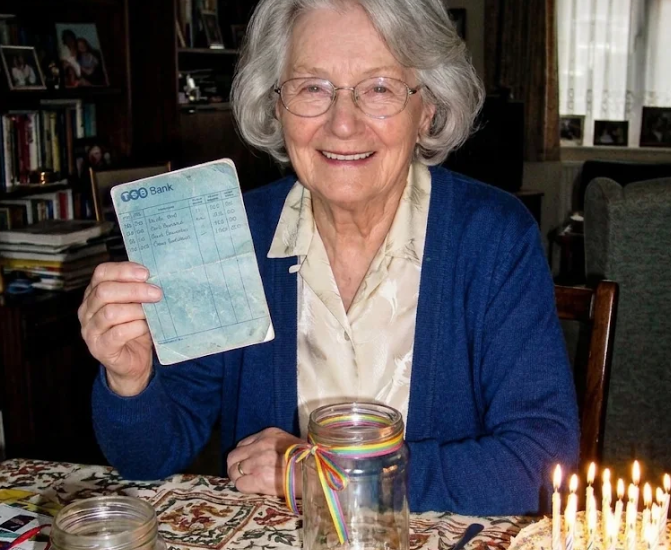
My son Noah is nine. For six months before my mother’s seventy-fifth birthday, he raked leaves, walked our neighbour’s dog, and carried groceries for the old man across the street.
Every coin went into an old pickle jar on his windowsill.
He didn’t spend a cent. Not on candy, not on games. When his friends went to the arcade, he stayed home.
“It’s for Grandma,” he said. “She always gives me stuff. I want to give her something big.”
I’ve been a single mom since Noah was three. Money is tight. We rent a small apartment. I work as a medical receptionist. We don’t have much, but Noah has never once complained.
My older sister Tara is married to a dentist. She lives in a big house with a pool and has never let me forget the difference between our lives.
Mom’s birthday dinner was at Tara’s house. The whole family. Twenty people.
When it was time for gifts, Tara went first. She handed Mom a designer handbag. Six hundred dollars, she told everyone. She said the price twice.
Then Noah stood up. He carried the pickle jar in both hands, carefully, like it was full of eggs. He’d tied a ribbon around the lid.
“Happy birthday, Grandma. I saved it for you. It’s eighty-three dollars and forty cents. I counted three times.”
Mom’s eyes filled up immediately.
Before she could say anything, Tara laughed.
“Oh my God. A jar of coins? Kelly, that’s so embarrassing. Couldn’t you at least have bought her a card?”
A couple of people laughed with her.
Then Tara reached over, took the jar out of Mom’s hands, unscrewed the lid, and tipped it upside down onto the tablecloth.
Coins went everywhere. Pennies rolled off onto the floor.
“There,” Tara said. “Let’s count the big fortune.”
Noah’s face went red. His lip started shaking. He looked at me, and I saw my nine-year-old son learn for the first time what it feels like to be laughed at for being poor.
I wanted to grab him and walk out.
I didn’t say a word. I couldn’t. If I’d opened my mouth, I’d have said something I couldn’t take back in front of my mother on her birthday.
Then my mother did something nobody expected.
She didn’t say anything to Tara. She just started counting.
Slowly. Out loud. Every single coin. She sent one of the grandkids under the table for the pennies.
The whole room went quiet and watched her.
“Eighty-three dollars,” she said finally. “And forty cents. He’s right.”
Then she opened her purse and took out something I hadn’t seen in almost forty years.
A small, faded blue bank book.
She held it up and looked straight at me.
“Kelly. Do you remember this?”
I didn’t, at first.
Then she opened it to the first page and turned it toward me, and I saw the date. March 1987. And the first deposit.
$41.60.
I was nine years old in March 1987.
That year, for Mom’s birthday, I collected aluminium cans from the ditches along our road for four months. I turned them in at the scrapyard for pennies. I put every coin in a coffee jar. I gave it to her at her birthday dinner.
And my sister Tara, who was twelve, laughed at me. In front of everyone. “A jar of coins? That’s so embarrassing.”
The same words.
I’d completely forgotten. Mom hadn’t.
“The next morning,” Mom said to the room, “I took Kelly’s coins to the bank and opened a savings account in her name. I deposited every single cent. I never told anyone.”
She turned the pages slowly. Deposit after deposit. Every year in March, on the anniversary of that birthday.
“Every year, I added a little. Whatever I could. Some years it was ten dollars. Some years it was a few hundred. I never took anything out.”
She turned to the last page and handed it to me.
The balance was forty-six thousand, eight hundred and twelve dollars.
I couldn’t breathe.
“I was saving it for the day you needed it most,” Mom said. “I think that day is now. It’s for a down payment, Kelly. A house. Somewhere with a yard. For you and this boy.”
I started crying. Noah started crying. My mother was crying.
Then Mom turned to Noah. She took his hands.
“Tomorrow morning, you and I are going to the bank. We’re going to open an account in your name, and we’re going to put every one of these coins in it. And I’m going to match it.”
“You don’t want to keep it, Grandma?” Noah whispered.
“Sweetheart, I’m keeping it. That’s what this is. This is how I keep it.”
Then, finally, Mom looked at Tara.
Tara’s face had gone completely red. The six-hundred-dollar handbag was sitting on the table between them.
Mom didn’t raise her voice.
“Thirty-eight years ago, you laughed at your sister’s coin jar. Tonight you laughed at her son’s. A coin jar is the most expensive gift anyone has ever given me. Because it costs a child everything they have.”
Tara didn’t say anything. Nobody did.
She came to my apartment the next week, alone. She sat on my couch and cried and said she didn’t know why she did it, except that she’d always been jealous that Mom and I were close in a way she and Mom never were.
I believed her. I’m still a little angry. But I believed her.
In April, Noah and I moved into a small two-bedroom house with a crooked fence and a big maple tree in the back yard.
The pickle jar is on the mantel. It’s empty now.
Noah says it’s not empty.
He says it’s waiting for Grandma’s eightieth.