
My grandmother, Evelyn, has lived in the same yellow farmhouse for fifty-six years.
She and my grandfather bought it in 1970 for eleven thousand dollars. She raised four kids in it. She planted every rosebush along the front walk. When Grandpa died nine years ago, she kept the house running by herself: mowing, canning, shoveling the porch steps every winter.
I’m a nurse. I work twelve-hour shifts at the county hospital, and on my days off I drive out to see her. We play cards. She beats me every single time.
Last spring, Grandma fell on the back steps and broke her hip. After the surgery, my Aunt Carol, her oldest daughter, stepped in.
Carol lives twenty minutes away in a big house with a three-car garage. She’d never been especially involved before. But suddenly, she was everywhere. She talked to the doctors. She took over the mail. She had Grandma sign a power of attorney “just so I can pay your bills while you heal, Mom.”
Grandma signed it. She trusted her daughter.
Last Saturday was Grandma’s eightieth birthday. Carol threw a party at her house. Thirty relatives. A catered lunch. A big sheet cake with roses on it.
After the cake, Carol tapped her glass.
“I have some wonderful news,” she said, smiling. “As most of you know, Mom has been struggling since the fall. That big old house is too much for her. So I’ve taken care of everything.”
She put her hand on Grandma’s shoulder.
“I’ve sold the house. We close on Friday. And Mom has a lovely room at Maple Grove starting next month.”
I froze.
Maple Grove is the cheapest nursing home in the county. I’ve transferred patients there. It’s the kind of place where call lights blink for forty minutes before anyone comes.
“It’s for her own good,” Carol added, to the whole room. “Somebody had to make the hard decision.”
A few relatives nodded. Somebody said, “That’s very responsible of you, Carol.”
I looked at my grandmother.
She hadn’t moved. She was sitting very straight in her wheelchair, her hands folded on her lap, her face perfectly calm.
She didn’t cry. She didn’t argue. She didn’t say a single word.
She just turned her head slightly toward me and said, very quietly, so only I could hear:
“Amy. Can you drive me to the bank on Monday morning?”
I didn’t understand. But I said yes.
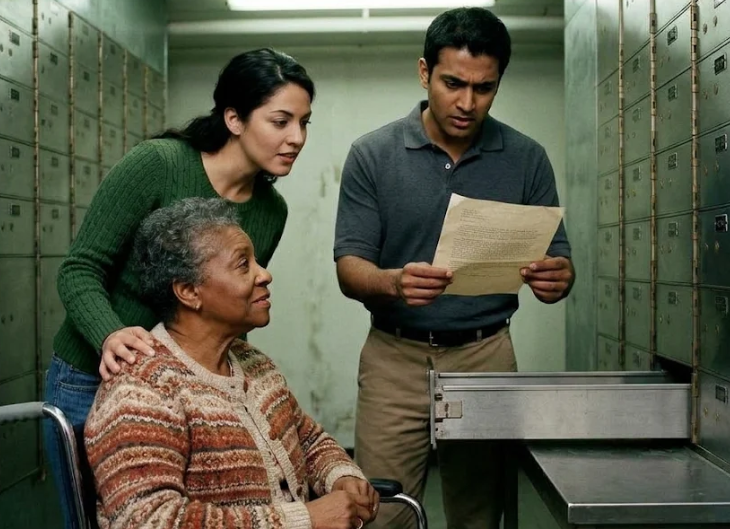
On Monday, I picked her up at nine. She’d put on her good lavender cardigan and her pearl earrings. She had a little brass key on a ribbon around her wrist.
At First National, she asked for the branch manager by name. Mr. Pierce. He’d been there for thirty years.
He brought us back to the vault. He used his key and Grandma’s key to pull out a long metal safe deposit box and set it on the table.
Grandma nodded at him. “Go ahead, Tom. Read it.”
He lifted out a folded legal document from the top of the box and unfolded it.
I watched him read the first page.
Then I watched the color drain out of his face.
He looked up at my grandmother.
“Mrs. Hale,” he said slowly. “Does your daughter know about this?”
Grandma smiled for the first time all week.
“No, Tom. She doesn’t.”
Mr. Pierce turned the document so I could see it.
It was a revocation of power of attorney. Signed by my grandmother. Notarized. Dated fourteen months ago.
“I don’t understand,” I said. “She signed the power of attorney after the fall. Last spring.”
“No, honey,” Grandma said. “She had me sign a new one last spring. She had me sign the first one two years ago. When I had pneumonia. She said it was just in case.”
She reached into the box and pulled out a small spiral notebook. The kind she keeps her grocery lists in.
“Six months after that, I noticed money missing from my checking account. Two hundred dollars here. Five hundred there. Then two thousand. I called the bank, and Tom showed me the withdrawals. Every one of them was Carol.”
She opened the notebook. Inside, in her careful handwriting, was a list. Dates. Amounts. Check numbers.
The total at the bottom was underlined twice.
$47,300.
“I didn’t want to believe it,” Grandma said quietly. “She’s my daughter. My firstborn. So I didn’t say anything to her. I just went to a lawyer. I revoked the power of attorney, and I had the lawyer file it with the county and with the bank. Then I put a copy in here and waited to see what she’d do.”
Mr. Pierce cleared his throat.
“Mrs. Hale. The second power of attorney, the one she had you sign after your surgery…”
“I was on morphine,” Grandma said. “I don’t remember signing it. My lawyer says that makes it worthless. He’s very excited about it.”
There was one more thing in the box. A letter from her attorney, dated last month. It said that the property known as 412 County Road 9 had been placed in a living trust, with Evelyn Hale as sole trustee. That no one else, under any power of attorney, had authority to sell it.
Carol had been trying to sell a house she had no legal right to touch.
Mr. Pierce picked up his phone right there in the vault. He called the title company handling Friday’s closing. I listened to his half of the conversation. He used the words “invalid authority” and “potential fraud” and “you’ll want your legal department.”
The sale was cancelled by noon.
Carol called me at 3:15 that afternoon. She was screaming. She wanted to know what I’d done, what lies I’d told Grandma, how I’d “turned her own mother against her.”
I let her finish.
“Aunt Carol,” I said. “Grandma knew for fourteen months. She was waiting to see if you’d stop.”
The line went quiet.
I learned later from my mom that Carol had already spent part of the expected sale money. She’d put a deposit down on a lake cabin. She’d told her friends at church that Mom was “declining” and “confused.”
Grandma’s lawyer gave Carol a choice. Repay the $47,300 within ninety days, or the bank’s fraud department and the county prosecutor would get the notebook.
She repaid it in sixty-one. She had to sell the boat.
Grandma never moved to Maple Grove.
I moved in with her instead. I’d been renting a small apartment in town, and it seemed silly to keep paying for it when there were three empty bedrooms in the yellow farmhouse. I work my shifts, and on my days off, we play cards on the back porch.
She still beats me every time.
She’s walking again too. With a cane, slowly, but walking. Last week she made it all the way down the front walk to inspect her rosebushes and informed me I’d been pruning them wrong.
The rest of the family was shocked when the truth came out. Some of them apologized to Grandma for believing Carol about her “declining.” She was gracious about it. She’s gracious about everything.
Carol hasn’t visited since. Grandma sends her a birthday card anyway.
“She’s still my daughter,” she told me. “I’ll love her until the day I die. I just won’t give her my checkbook.”
The safe deposit box key still hangs on its ribbon by the back door.
Last night, while we were playing gin rummy, I asked her why she hadn’t said anything at the party. Why she just sat there and let Carol announce it in front of everyone.
Grandma laid down her winning hand and looked at me over her glasses.
“Because, sweetheart,” she said, “when you’re holding all the cards, you don’t have to show them until the very end.”