
For months, every Saturday morning followed the exact same ritual. My best friend, Chloe, would pull into my driveway at nine o’clock sharp, honk twice, and take my eighteen-year-old son, Leo, out for breakfast. At first, I assumed they were rotating through different spots around town. It wasn’t until I noticed the same blue paper receipt tucked into Leo’s jacket pocket week after week that I realized they were going to the exact same place: The Blue Spoon, a quiet neighborhood diner ten minutes down the road.
Leo is autistic, and busy public spaces can easily overwhelm him. Loud clattering dishes, rushed servers, and people leaning in too close usually send him retreating inward, headphones clamped tight over his ears. Knowing how unpredictable restaurants could be for him, I couldn’t understand why he never came home drained or anxious after his mornings with Chloe. In fact, he came home calmer, carrying himself with a quiet brightness I hadn’t seen in years.
One Saturday, when Chloe had a flat tire and asked if I could meet them at the diner after she got it patched, I walked through the glass doors of The Blue Spoon a few minutes ahead of her. Before I could even reach the counter to ask for a booth, a warm-faced waitress in her fifties looked up from the coffee station and smiled.
“Morning, Leo!” she called out cheerfully, keeping a respectful distance behind the counter. “Your usual corner spot is open, and I just put fresh napkins by the register if you feel like sorting them later.”
I stood frozen in the doorway. Leo didn’t flinch or pull back. He simply nodded, gave a small, steady wave, and walked calmly toward the back booth as if he belonged there.
The waitress—whose nametag read Marcy—glanced at me, noticed my stunned expression, and smiled knowingly. “You must be Leo’s mom,” she said softly, stepping closer only when she saw I was alone. “Chloe told us you might drop by today.”
“You know him?” I asked, my voice barely above a whisper. “He doesn’t usually handle diners well.”
Marcy wiped her hands on her apron and leaned lightly against the counter. “When Chloe first started bringing him in four months ago, she came by on a Tuesday afternoon all by herself first. She sat right here and explained everything—not like a list of warnings, just who Leo is. She asked us not to rush him when he orders, to avoid sudden touch or loud greetings right in his face, and to give him a full ten seconds to answer before repeating a question.”
My throat tightened as Marcy continued. “She didn’t ask us to treat him like a child. She asked us to treat him like a regular who just appreciates a steady pace. After a few weeks, Leo noticed our sugar packets and napkin holders were always messy after the morning rush. He started lining them up neatly by color and size. Our manager saw how focused and reliable he was, and pretty soon, Leo wasn’t just visiting—he was helping.”
Just then, the bell above the door chimed and Chloe walked in, offering me a sheepish smile when she saw me talking to Marcy. Before I could even thank her, Marcy smiled toward the back booth and added, “Actually, our manager spoke with Chloe last week. If you and Leo are open to it, we’d love to offer him a paid three-hour Saturday morning shift starting next month.”
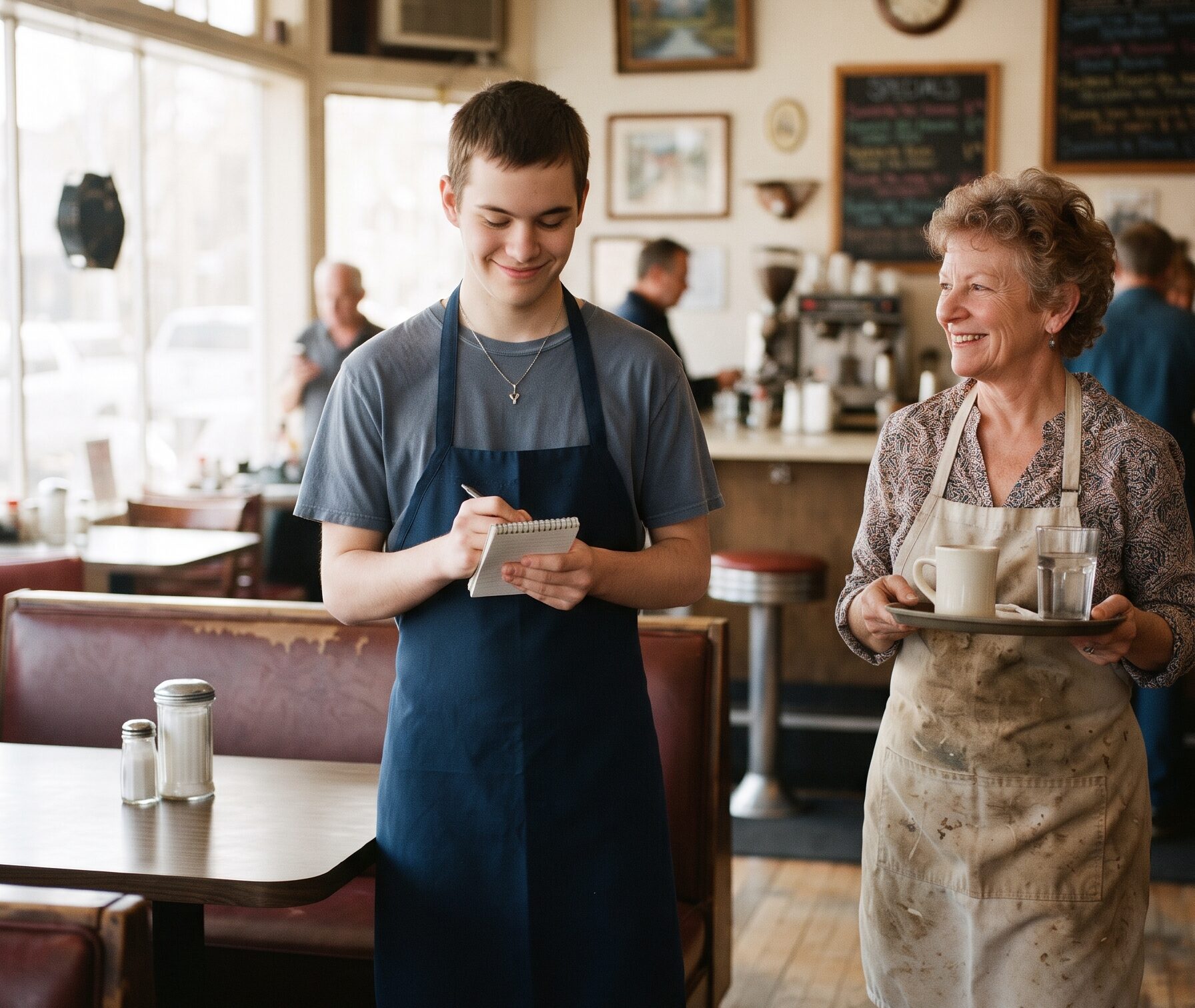
Three weeks later, I sat in that same corner booth with my coffee, watching through tears I tried hard not to let fall as Leo tied a crisp navy apron around his waist. With a small notepad in hand and zero prompting from anyone, he walked up to a table of regulars, waited patiently while they spoke, and took their breakfast orders entirely on his own. For eighteen years, I had spent so much energy trying to shield Leo from the world and speak for him so others wouldn’t misunderstand him. Watching him stand tall behind that counter, I realized he never needed someone speaking over him—he just needed people willing to leave him room to respond.
Six weeks into his Saturday job, Leo’s quiet attentiveness proved even more remarkable than any of us could have imagined. Every Saturday at 9:30 AM, an eighty-two-year-old widower named Mr. Howard sat at table four for oatmeal and black coffee. That morning, the clock ticked past ten, and table four remained empty. While the rest of the staff moved through the busy morning rush, Leo paused beside the register, looking repeatedly at the clock and then at the empty booth.
“Mr. Howard is late,” Leo said clearly to Marcy. “He is never late. His blue car is not outside.”
Marcy hesitated at first, assuming the older man had simply slept in or visited family. But Leo didn’t let it go. He walked over to the bulletin board near the kitchen where regular customers left emergency contact cards for the diner’s annual holiday raffle, pointed directly to Mr. Howard’s name, and repeated, “Something is wrong.”
Trusting Leo’s instinct, Marcy called the number listed for Mr. Howard’s daughter, who lived two towns away and hadn’t heard from her father since Thursday evening. Within twenty minutes, local paramedics arrived at Mr. Howard’s house and found him conscious but weak on his living room floor, where he had fallen nearly two days earlier and been unable to reach his phone. Doctors later told his daughter that another few hours without water or medical help could have been fatal.
The following Saturday, Mr. Howard’s daughter came into The Blue Spoon with a handwritten thank-you card and a basket of fresh peaches for Leo, tears streaming down her face as she thanked him for noticing what everyone else had overlooked. Leo simply nodded, accepted the card with both hands, and went back to lining up the napkin holders.
Looking at my son alongside Chloe and Marcy that morning, I understood something I will carry for the rest of my life. True love and true friendship don’t always look like stepping in to fix things—sometimes, the greatest gift you can give someone is stepping back in quiet confidence, clearing the noise, and letting their own voice and strengths shine through.