
Vance Tolliver had a coffee can wired to his gatepost.
He tapped it twice before he’d lift the chain.
“Twenty dollars. Per family, per day. Cash.”
My son Easton sat beside me in the truck with his backpack on his knees.
Six inches of rain had come down in one night the week before, and the creek had torn out our low-water crossing like it was made of cardboard. The county said it would take six months to replace it. The only other way out of our hollow was thirty-one miles of dirt road that had turned to soup.
Or straight across Vance’s pasture. Through his gate.
The sheriff couldn’t do anything. It was Vance’s land. Vance’s gate.
So I paid him.
Then I watched Ardith Pyle pay him in the truck behind me. A ten, a five, and five ones. Counted out slow.
Ardith cleans houses for thirteen dollars an hour and raises three kids by herself. Twenty dollars a day is a day and a half of her work. For six months.
That morning, her four-year-old, Josie, had asked her a question she told me about later, standing by my truck with her eyes red.
“Mama, are we poor now? Because we have to pay to go to school?”
I want to be fair to Vance.
Five years ago, the last big flood took out the same crossing, and every truck on our road cut through his hay meadow for two months. It rutted so bad he lost a whole cutting. Nobody paid him a dime. Nobody even said sorry.
“I’m doing it so I’m not the only one paying for that creek this time,” he told me through my truck window.
“Those kids didn’t rut your meadow,” I said.
He just tapped the can.
I’m a pipeline welder. Have been for eleven years. My husband was on a two-week hitch in West Texas. I called him on my lunch break, sitting on a pipe rack with my hood flipped up.
“How wide’s the creek?” he asked.
“Sixteen feet. Bank to bank.”
He was quiet for about three seconds.
“Then build it,” he said.
The pusher at our yard had a rack of scrap drill pipe nobody wanted. Bent, pitted, too worn for the hole. Perfect for a bridge. He sent six joints and four oak rig mats on a flatbed for free.
“Pusher says his grandkids ride a bus too,” the driver told me, and drove off before I could argue.
Our old neighbor, Hub McCready, welded on drilling rigs for forty years. He’s seventy-seven, and his hands shake now, but his eyes don’t. He came down to the creek with a lawn chair and a thermos and checked every weld I made.
Once, he put his finger on one without saying a word.
I ground it out and did it again.
Saturday, we laid four joints of pipe across the creek and set them in concrete on both banks.
Sunday, the pastor said grace on a tailgate, and then he took off his tie and helped us carry planks. Half the congregation came. We decked it with oak and bolted every single board down. Pipe rails on both sides, low enough for the little ones to hold onto.
When it was done, eleven grown men climbed on and jumped at the same time.
It didn’t move an inch.
Up on the hill, the whole weekend, Vance sat on his tailgate and watched us. He never came down.
Monday morning was bright and green after all that rain.
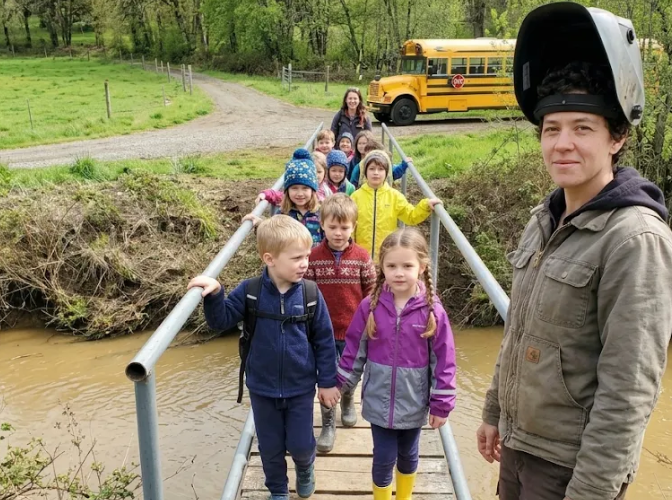
Fourteen kids lined up on our side of the creek with their bright backpacks. I stood at the end of the bridge in my navy work shirt, hood flipped up, braid down my back. The creek ran brown and fast under the gray pipe rails. The yellow school bus sat waiting on the gravel road on the far bank.
“Single file,” I said. “One hand on the rail.”
Easton went first. Then he stopped on the very first plank and turned around.
Josie, Ardith’s littlest, was staring down at the water through the gaps between the boards. She wasn’t moving.
My son held his hand out to her.
She looked at it for a long time.
Then she took it.
They started across together, one plank at a time. Thirteen more followed behind them, sneakers loud on the oak.
Nobody drove up to that gatepost. Nobody had a twenty in their hand.
Then, up on the hill, I heard his gate chain rattle.
Every parent on the bank turned around.
Vance was coming down the hill on foot. Slow. He’s sixty-eight, and he’s got a bad hip. He was carrying the coffee can under one arm and a spiral notebook in his other hand.
Nobody said anything. Ardith stepped closer to her kids.
He stopped at the end of the bridge, right next to me. He looked at it for a long time. The welds. The rails. The bolts in every plank.
“Hub check your welds?” he asked.
“Every one.”
He nodded. “Then it’ll hold.”
He watched the last of the kids step off the far end and climb onto the bus. Easton and Josie were still holding hands.
Then Vance turned around to face the parents.
“I owe y’all some money,” he said.
He opened the spiral notebook. Every page was lined in his careful, old-fashioned handwriting. Dates. Names. Amounts. Every single twenty, from every single family, every single day.
“I wrote it all down,” he said. “Didn’t know why at the time. Guess part of me knew I’d be handing it back.”
He pulled the lid off the coffee can. It was full of folded bills.
He went down the list right there on the creek bank, counting out cash into each parent’s hand. He got to Ardith last.
He counted out her money. A hundred and forty dollars. Seven days.
Then he kept counting. Another hundred. Another hundred after that.
“Vance, that’s too much,” Ardith said.
“It’s not,” he said, without looking up. “I heard what your little one asked you. About being poor. The whole road heard it. I’ve been thinking about it every night since.”
He put the cash in her hands and closed her fingers around it.
“Nobody in this hollow is poor because of a creek,” he said. “Not while I’m living.”
Then he turned to me.
“Five years ago, when they cut up my meadow, my wife was dying,” he said quietly. “Hospice was coming out every day. I couldn’t make the payments on the hay equipment without that cutting. I almost lost the place. And nobody on this road asked me how I was doing. Not one person. So I sat up there with my can and told myself I was getting even.”
He looked at the bridge.
“But I was getting even with the wrong people. And I’ve been sitting on that tailgate all weekend watching you all build something, and I was the only one on this whole road who wasn’t down here helping.”
Hub McCready, from his lawn chair, said, “You still could, Vance.”
Vance looked at him.
“Approach on the far side’s still mud,” Hub said. “Those kids are going to be tracking it on the bus all winter. Somebody with a tractor and a gravel pile could fix that in an afternoon.”
Vance was quiet for a moment.
Then he almost smiled.
That afternoon, he brought his tractor down with a front-end loader full of crushed rock. He graded both approaches and packed them down until they were flat as a driveway. The next day, he came back with a sign. He’d painted it himself, white letters on an old barn board, and he bolted it to the pipe rail.
EASTON & JOSIE CROSSING
He took the coffee can off his gatepost that same day. He left the gate open. For the six months it took the county to rebuild our crossing, anybody who needed to cut through his pasture with a truck could, free.
Nobody rutted his meadow. People drove slow. A couple of the dads went up in October and helped him put up his hay.
When my husband came home from his hitch, he walked down to the creek before he even came in the house. He stood on the bridge for a long time. Then he jumped on it, hard, like the eleven men had.
“Didn’t move,” he said, grinning.
“Hub checked every weld,” I told him.
The county finished the new crossing in April. It’s concrete, with culverts, built for a hundred-year flood.
We left the bridge anyway.
The kids still use it every morning. They like it better. They say you can see the crawdads through the gaps in the planks.
Vance walks down most mornings with his coffee and stands at the end of it while they cross. He says it’s to make sure nobody falls in.
I think it’s because Josie waves at him every single time.
And every single time, he waves back.