
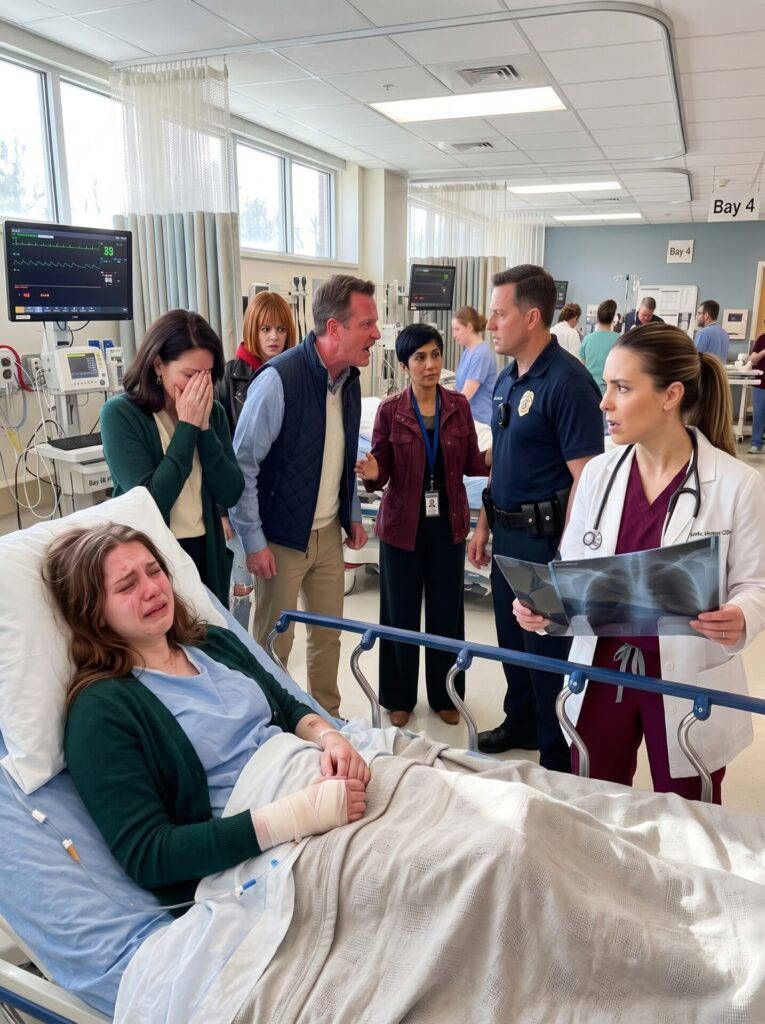
Miranda Caldwell lay in the ICU staring at the clock across from her bed while the machine beside her breathed in soft, steady sighs. Her thumb shook as she called her mother, then her father, then the family group chat, counting every unanswered attempt because there was nothing else to do but watch the minutes crawl. Nine calls went nowhere. The only response was a text from her mother: “We’re at Lauren’s. Is this urgent?” Miranda had been rushed into surgery the night before after a delivery truck ran a red light and crushed her sedan, collapsing her lung and forcing doctors to remove her spleen. While she lay under fluorescent lights with tubes in both arms, her parents were across town helping her sister unpack a new house. At 6:40 p.m., when Lauren posted a smiling video thanking Mom and Dad for moving furniture, Miranda pressed the call button and asked the nurse to dial her estate attorney.
Miranda had always known she came second to Lauren, but the accident made the truth impossible to soften. Lauren’s dance recitals had once outranked Miranda’s science fairs, Lauren’s breakups had disrupted Miranda’s milestones, and Lauren’s comfort had become the organizing principle of the Caldwell family. What her parents did not fully understand was that Miranda’s medical software company had sold two years earlier for enough money to change all of their futures. Her parents knew she was wealthy, but they did not know the full value of her estate, the lake house they treated as a family retreat, the education trust they assumed Lauren’s future children would inherit, or the retirement care plan Miranda had quietly funded for them. They also did not know they were still listed in her will. By 8:15 that night, attorney Julian Vance stood at the foot of her hospital bed, reading amendments aloud while monitors marked every fragile heartbeat.
Miranda removed her parents and Lauren from every beneficiary line, revoked family access to emergency accounts, changed her healthcare directive, and reassigned financial power of attorney to Julian’s firm. Her hand shook from blood loss and medication, but the hospital documented her legal capacity, and two nurses witnessed every signature. At 10:03 p.m., her mother finally walked into the ICU carrying takeout coffee, followed by her father and Lauren, all three looking more annoyed than frightened. When her mother said Miranda had scared them, Miranda answered, “No. You scared me.” Then Julian closed his briefcase, nurse Marisol confirmed the family had ignored a critical emergency call, and Miranda told them the documents were already done. That was when her father asked the only question that truly mattered to him: what, exactly, had she changed?
The answer landed harder than any accusation could have. Miranda’s updated estate plan removed the lake house, trust distributions, foundation board seats, mortgage assistance, medical authority, and any inheritance her family had assumed would remain available no matter how they treated her. Her estate would now fund the Caldwell Patient Recovery Foundation, supporting trauma care, ICU family lodging, emergency transportation, and nursing scholarships. When Lauren learned Miranda had paid for her Ridgefield down payment and half their parents’ mortgage through accounts disguised as medical and property expenses, the family turned on itself in the room. Julian calmly explained that the changes were legal, properly witnessed, and defensible in court, while Marisol reminded everyone that Miranda was awake, oriented, and her patient. For the first time in Miranda’s life, her father could not command the room, her mother could not cry her way around the truth, and Lauren could not stand at the center without seeing who had funded the stage beneath her.
Recovery was not dramatic; it came in slow breaths, painful steps, paperwork, scans, and nights when peace felt almost as lonely as grief. Her parents tried to challenge the will and failed, undone by hospital records, missed-call logs, witness statements, and Lauren’s own timestamped social media posts from the day of the accident. The lake house sold that autumn, the foundation launched the following year, and Marisol became one of its first scholarship recipients while families of ICU patients began receiving hotel rooms near hospitals instead of sleeping in cars or plastic chairs. One evening, outside the ICU entrance after a follow-up scan, Miranda watched a man sleeping beside a patient’s bed with his hand still wrapped around hers. Her phone buzzed with a message from her mother saying she missed her daughter. Miranda deleted it, not because she hated her mother, but because she finally believed the emergency of her own life had always been worth answering.

