
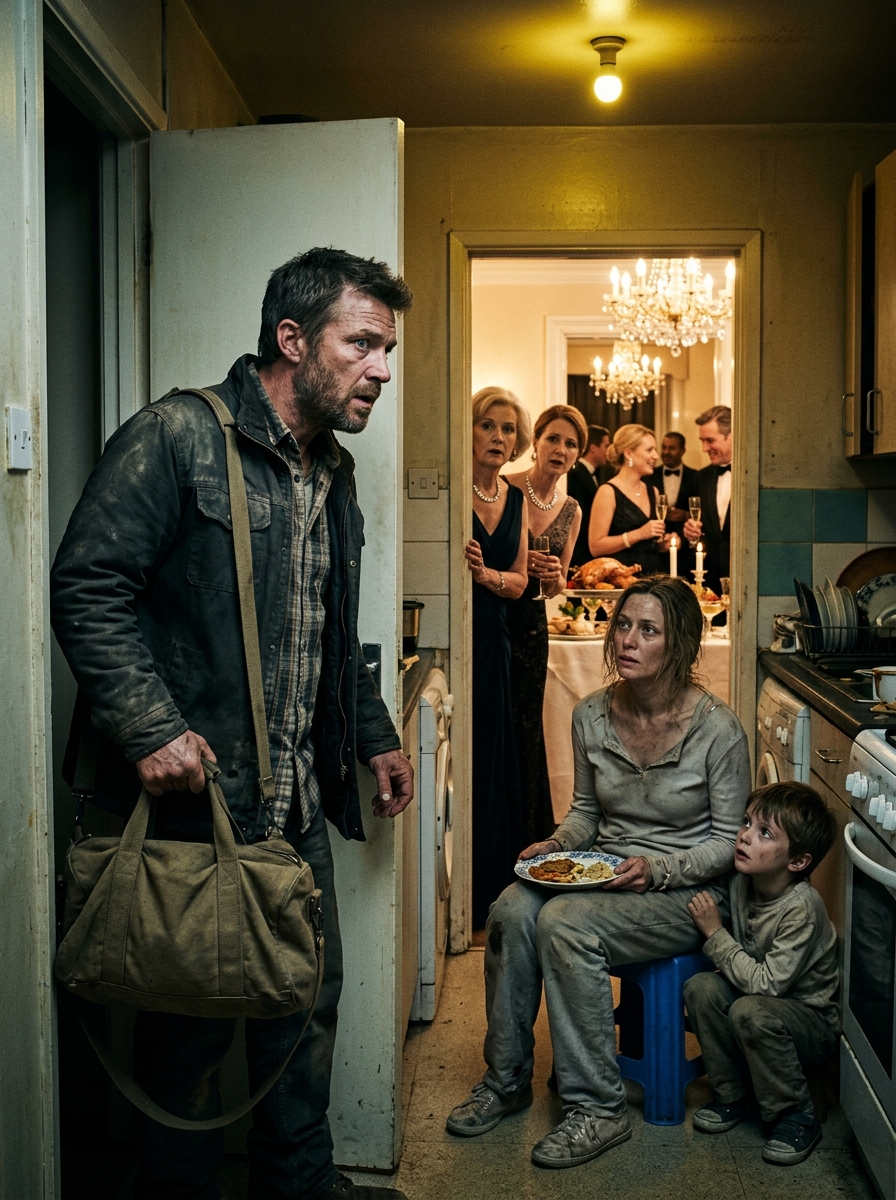
I came back from Saudi Arabia after five brutal years of work, expecting to surprise my family—only to find my wife and son hidden behind the mansion I had paid for, hungry and forgotten, while my mother and sister threw a party inside.
Part 1: The Call Home
I came back from Saudi without telling anyone.
Not my mother. Not my sister. Not even my wife.
For five years I worked heat, steel, dust, and twelve-hour days. I sent money home every month. Eighteen hundred dollars, wired straight to my mother, Carmen. Lira didn’t have an account when I first left, and I made the mistake men make when they still think blood means trust.
Every month I told her the same thing. Take care of my wife. Take care of my son. Every month she fed me the same lies. Lira’s out shopping. She’s busy. Leo’s fine. Don’t worry.
I believed her because I wanted to.
My contract ended early. I decided to come home quiet. I wanted to see Lira’s face when I walked in. I brought chocolates, a gold bracelet, and a box of toys for Leo.
The house was outside Houston. Big. Expensive. The kind of place that says success before anyone opens their mouth.
When I pulled up, something felt wrong.
Music. Lights. Cars. Laughter.
A party.
I didn’t go through the front. I cut around back, through the service entrance.
That’s when I heard my son.
“Mom… I’m hungry. I want the chicken from inside.”
Then Lira.
“Shh, baby. Don’t make noise. If Grandma hears us, she’ll yell again. Eat this. I washed the spoiled rice.”
I stopped cold.
I stepped into the back kitchen and saw my wife sitting on a plastic stool under a weak bulb, feeding my son off a chipped plate. Torn dress. Hollow face. Thin wrists. Two changes of clothes stacked against the wall. A pillow. A bucket. A pot.
They weren’t living in the house.
They were living behind it.
Then the door to the main kitchen opened and Valerie walked in carrying a silver tray full of roasted chicken.
She saw me.
The tray shook.
My mother stepped in behind her. She looked at the gifts on the floor. Then at me. Then at Lira and Leo.
The color drained out of her face.
In that second I understood everything.
They had taken my money, my house, my wife, my kid, and turned all of it into a stage.
And I had paid for the whole show.

Part 2: The Table
Leo looked at me like he wasn’t sure I was real.
“Papa?” he said.
I picked him up. He held on like he thought I might disappear if he loosened his grip.
Behind me, my mother said, “This is not what it looks like.”
I turned and said, “Then explain it.”
Valerie got there first. “Don’t be dramatic. They’re eating back here because the party’s inside.”
Lira dropped her eyes.
That told me more than any lie they could say.
I crouched in front of her. “Look at me.”
She did, barely.
“Come inside,” I said.
My mother snapped, “No.”
Leo flinched at her voice. Lira went stiff. That was enough.
I picked up the plate of spoiled rice and walked straight into the dining room.
The room went quiet one table at a time. Guests turned. Glasses stopped moving. The music kept going for a few seconds too long, then somebody killed it.
I set the plate in the middle of the table.
“This,” I said, “is what my wife and son were eating behind the house while you were being served this.”
Nobody had anything to say.
Ethan, Valerie’s fiancé, stood there holding a drink, looking like a man who had just realized he’d wandered into the wrong family.
My mother tried to fix it. “Lira insisted on staying back there. She gets overwhelmed.”
I ignored her. I took Lira by the wrist, led her in, and seated her at the head of the table. Leo sat next to her. He looked half-afraid to touch the bread basket.
Then I asked the only question that mattered.
“When did they move you out of our room?”
Lira said, “Three months after you left.”
My mother said, “That is a lie.”
I looked at her once. “You talk again while she’s speaking and I’ll remove you myself.”
She shut up.
Lira kept going. My mother took the front suite. Said it was temporary. Then said the master should be kept formal for guests. Then said it was easier if Lira and Leo stayed in the back until things settled.
Things never settled.
“Did you have a phone?” I asked.
“At first,” Lira said.
“What happened to it?”
My mother jumped in. “She lost it.”
Lira closed her eyes. “Your mother took it. Said calls to Saudi cost too much. Said you had debts. Said I should be grateful we were allowed to stay.”
The room died right there.
Valerie tried one last move. “She was ungrateful. And the boy was wild.”
“He’s six,” I said.
“Exactly,” my mother snapped. “Old enough to learn.”
No one at that table looked at her the same after that.

Part 3: The House
I pulled up the bank app on my phone.
My mother saw it and said, “What are you doing?”
“Undoing five years.”
I opened the wire account. Every transfer I had sent from Saudi was there. Month after month. Then I opened the authorized-user section.
Carmen. Valerie.
I removed both.
Their phones buzzed at the same time.
Valerie checked hers first and went pale. My mother checked hers second and looked like she’d been hit.
Then I called the bank’s fraud line and reported suspected misuse of support funds meant for my spouse and minor child. I told them to freeze outgoing transfers and flag the last sixty months.
When I hung up, Valerie said, “You can’t do that.”
“I just did.”
Then I went to the safe behind the study shelf.
I pulled out the trust folder and brought it back to the table.
“This house,” I said, “is not in your name. Not yours either.”
I looked at my mother, then Valerie.
“I bought it through the Mercer Family Trust before I left. Lira is co-trustee and primary residential beneficiary. If anything happened to me, full control passed to her, then to Leo.”
Lira stared at me. She hadn’t known.
That one cut deep. I had thought I was protecting her by handling the paperwork myself. All I had really done was leave room for my mother to lie.
Valerie’s fiancé looked at the documents, then at her. “You told me this place was basically yours.”
Valerie said, “It is family property.”
“No,” I said. “It’s my wife’s house.”
I slid the occupancy clause across the table. My mother read it and knew what was coming before I said it.
“You have one hour to pack.”
She stared at me. “You would throw your own mother out at night?”
I looked at the plate of rotten rice still sitting between the centerpieces.
“You threw my family out four years ago. I’m correcting the address.”
Valerie screamed. My mother cried. Ethan took off his ring and set it in front of Valerie.
Then he said, “Don’t call me again,” and walked out.
The rest of the guests followed him.
No one wanted to stay in a house once the truth got louder than the champagne.
Part 4: One Hour
Security got there in twelve minutes.
I showed them the deed, the trust, the ID. My attorney confirmed everything on speakerphone. The supervisor took one look at the room and said to my mother, “Ma’am, gather your belongings.”
My mother tried tears first. Then outrage. Then the old line about family.
None of it worked.
Valerie tried to pocket silverware and a bronze statue from the foyer before the guard stopped her. She threw a fit. Called me every name she knew. My mother stood there shaking and saying I’d regret humiliating her.
I told her, “I regret sending you money while my son learned not to ask for food.”
That ended the conversation.
Forty-two minutes later they were out.
The front door shut behind them and the whole house changed.
No music. No fake laughter. No perfume and lies hanging in the air.
Just silence.
A real silence.
I looked at Lira. She looked at the floor, then the walls, then me, like she still wasn’t sure she was allowed to stand in the middle of the room.
“We’re not sleeping in the back,” I said.
She asked, very quietly, “Can we stay here?”
That nearly broke me.
“Yes,” I said. “Anywhere you want.”
We didn’t touch the master bedroom that night. Too much poison in it.
Leo slept in the study because he didn’t want to be alone. Lira showered in the guest suite and came out looking clean, exhausted, and wary. I ordered real food. Burgers. Soup. Pancakes for Leo because he called them celebration food and then looked scared for saying it.
At two in the morning, I sat in the office with five years of bank statements spread across the desk.
Designer stores. Spa appointments. Resort weekends. Valerie’s car payments. Jewelry. Catering. Wine orders. Furniture. Private school donations she made in her own name. All funded by money I sent for my wife and son.
By sunrise, my attorney had the full file.
By noon, the forensic accountant did too.
By evening, every card, gate code, and account tied to my mother and sister was dead.
The next phase had started.
Part 5: Repair
The lawyers did their work.
So did family services.
The money trail was ugly. Over three hundred thousand misused. Food deprivation. Housing coercion. Communication interference. Neglect of a minor. Enough to bring in the right people and keep them there.
My mother called once.
She said, “After everything I did for you, you’d do this?”
I said, “You fed my child hunger while I financed your comfort.”
Then I hung up.
The harder part wasn’t the legal side.
It was home.
Leo hid food for weeks. Bread rolls in drawers. Crackers under his pillow. Half a chicken strip in a sneaker. Every time I found one, it felt like getting hit with a hammer.
Lira apologized for using rooms in her own house. Asked before opening cabinets. Flinched when footsteps came up behind her. She’d been trained into smallness, and now everything in her body expected punishment where there wasn’t any.
So I did the only thing I could.
I stayed.
I cooked. I cleaned. I sat with Leo while he ate. I walked Lira through every account, every document, every code. Her name went on everything. First.
No more middlemen. No more trust handed to the wrong blood.
Three months later, my mother tried to come back through cousins and church friends and one aunt who suddenly remembered my number. Valerie sent one nasty email and then got hit with a demand letter so detailed it shut her up for good.
The house got quieter.
Better.
Lira replanted the yard. Leo started laughing without checking the room first. He left half-finished juice boxes on counters and stopped hiding bread. That was how I knew we were finally moving.
Not because anybody said we were healed.
Because he stopped planning for hunger.
Part 6: Home
A year later, Leo asked if I was ever going back to Saudi.
He was sitting at the kitchen island in pajamas, cereal milk on his lip, sunlight all over the room that used to host people who thought he should eat after everyone else. Lira was at the stove making coffee, barefoot, humming to herself without even knowing it.
“No,” I said.
He looked at me hard. “Promise?”
I walked over and pushed his hair back. “Promise.”
That night Lira and I sat on the patio while Leo chased fireflies in the yard.
After a while she said, “When you walked into that kitchen, I thought I was dreaming.”
“So did I.”
Then she asked me, “Who did you look at first?”
I knew what she meant.
Not what I saw. Who I chose.
“You,” I said. “Then Leo.”
She nodded once. No speech. No dramatic forgiveness. Just that.
Sometimes that’s enough.
People like to think the big moment is when you throw someone out. It isn’t. The big moment is later. When the house is quiet. When your kid laughs with food in his stomach. When your wife walks through rooms without asking permission. When nobody is hiding behind the place you paid for.
That’s the real ending.
My mother thought blood made her untouchable.
Valerie thought money made her powerful.
They were wrong.
A house is not a home because your name is on the guest list. It’s a home because the right people are fed, protected, and never told to make themselves smaller so someone else can feel important.
They forgot that.
I didn’t.
And that’s why they lost everything.