
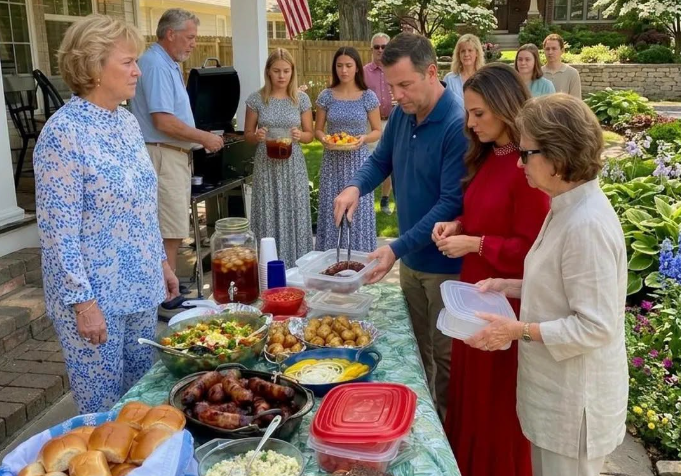
Betty Miller was standing beside her patio table when her son began packing her brisket into his wife’s plastic containers. The Texas heat still clung to the backyard, the grill smoked under Tom’s careful watch, and the long wooden table held the kind of Sunday spread Betty had spent two days planning. Thirty-three pounds of beef, roasted potatoes, garden salad, grilled onions, bread, iced tea, and the green tablecloth that had once belonged to her mother. Rachel, her daughter-in-law, pointed toward the softer pieces of brisket while her mother, Stella, opened another container as if the meal had been arranged for pickup. No one asked Betty. No one even looked at her. When Julian reached for the biggest container, filled with meat she had paid $250 for herself, Betty took it from his hands and said the three words that silenced the whole yard: “Please leave now.”
For most of her sixty-five years, Betty had believed feeding people was one of the purest ways to love them. Her home outside Fort Worth had held birthdays, graduations, Easter egg hunts, Fourth of July cookouts, and more Sunday dinners than she could count. She liked hearing the screen door open, liked seeing chairs dragged into the shade, liked sending guests home with enough leftovers to feel remembered. But over time, generosity had become something certain people treated as an entitlement. Rachel arrived polished and empty-handed, Stella arrived “particular” and critical, and Julian — once the boy who helped set the table without being asked — had learned to smile nervously whenever his wife crossed a line. Betty noticed the little things: the air kisses, the sharp comments dressed as honesty, the way Rachel and Stella’s eyes lit up not with gratitude but calculation when Tom mentioned how much beef was on the grill.
The meal began with polite smiles and small cuts. Stella called the house “lived in,” corrected the salt in the sausages, and inspected Betty’s roses like a judge at a county fair. Rachel photographed the food for social media, praising “home cooking” she had not helped prepare, then ate generously before announcing how awful it would be for the beef to go to waste. That was when the containers appeared, not one or two, but a stack from Rachel’s tote and more from Stella’s bag, ready before anyone had offered a single leftover. Julian stood and obeyed when Rachel told him what to pack. “Mom always makes too much,” he said lightly, as if that turned his mother’s labor and money into open inventory. Betty looked at the man her son had become in that moment — not cruel, exactly, but too afraid of conflict to recognize unfairness — and understood that the barbecue was no longer about meat. It was about dignity.
Rachel accused Betty of jealousy, Stella called her rude, and Julian asked his mother to apologize “just so everyone could calm down,” but Betty refused to make peace by swallowing disrespect. Tom stood beside her, Erica and Louisa confirmed what they had witnessed, and the party ended with Rachel leaving furious and Julian following her out instead of turning back. The silence lasted weeks, then a month, until Betty drove to San Antonio to stay with her sister Isabella and finally admit how tired she was of being taken from. Julian’s change came only after seeing Rachel repeat the same behavior at another family cookout, containers ready, criticisms prepared, entitlement disguised as normal. He returned to Betty with an apology that did not ask for immediate forgiveness, and that mattered. Over time, the family accounting changed: not legal paperwork, not an estate dispute, not insurance claims, but the quieter ledger of respect, responsibility, and trust that every family keeps whether it admits it or not.
Two years later, Betty still hosted Sunday barbecues, but she bought eleven pounds of beef instead of thirty-three. Erica brought corn salad, Louisa brought brownies, Isabella poured iced tea, and Julian helped set the table while his little daughter Sophia chased butterflies in pink sneakers. Betty still packed leftovers, but only after everyone had eaten and only because she chose to offer them. That was the difference: no one arrived with empty hands and hidden expectations; no one treated her kindness like a supply cabinet. Under the string lights that evening, Tom asked if she regretted saying those three words. Betty thought of the red dress, the containers, the long silence, the apology, and Sophia’s small arms around her neck. “No,” she said. Because in asking them to leave, she had finally made room for the part of herself that deserved to stay.

