
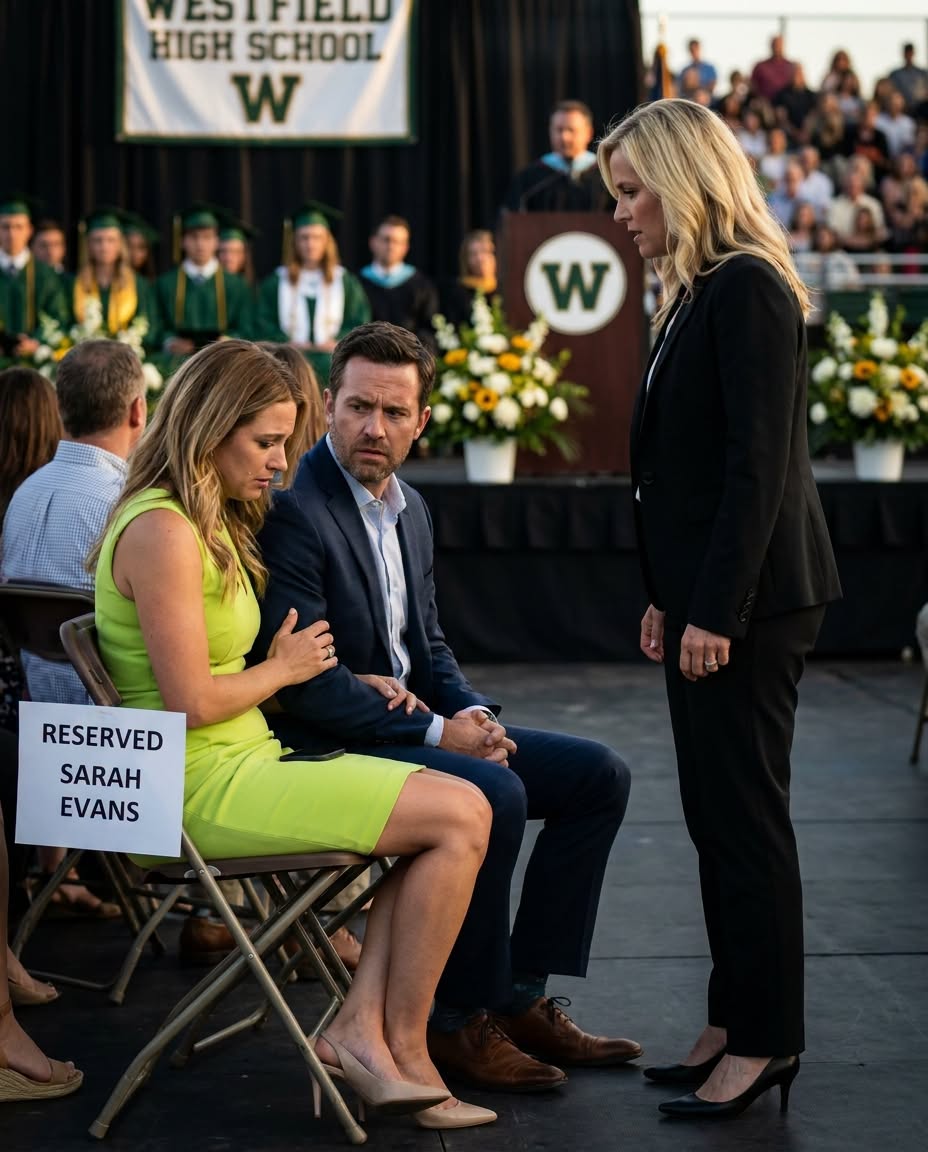
The usher was already waiting near the auditorium entrance when he told me I would have to stand beneath the red EXIT sign at the back. From there, I could see the second-row seat my son Michael had reserved for me that morning and the torn card bearing my name on the floor. Sitting comfortably in its place was Chloe, my ex-husband David’s twenty-eight-year-old wife, dressed for photographs and holding her phone at the ready. When I calmly said the seat was mine, she smiled and replied that Michael’s mother should be accustomed to watching from the back. David lowered his eyes to the graduation program and said nothing. I understood that Chloe wanted me angry enough to become material for one of her social-media stories, so I refused to give her the scene she had prepared. My sister Claire stood beside me while I watched the ceremony begin from the same place I had occupied for most of my son’s life—behind him, making sure he could move forward.
David left when Michael was six, and the years that followed were governed by the arithmetic of one inconsistent child-support payment, one clinic salary, and one child whose future mattered more than comfort. Michael slept in the only bedroom while I spent six years on a pullout couch, sewing hems and replacing zippers at night to cover the expenses my wages could not reach. David appeared reliably for ceremonies and photographs but disappeared when effort became ordinary, while Chloe gradually promoted herself online as Michael’s devoted “bonus mom.” Michael noticed who arrived for robotics practices, science fairs, scholarship deadlines, and winter drives in a car without heat. He became a disciplined student, earned national recognition in mathematics and engineering, and quietly collected the evidence of the life we had built together. That morning, he had hugged me in the parking lot and promised me the best seat in the room. I thought he was simply nervous, but he had already anticipated that someone might try to erase me.
When the principal introduced Michael as class valedictorian, six hundred people rose while I covered my mouth beneath the EXIT sign. At the podium, he folded his prepared speech, placed it in his pocket, and announced that something had happened that morning he could not ignore. He pointed toward Chloe, produced both halves of my torn reservation card, and said the school had preserved security footage showing exactly what she had done. Then the screen behind him filled with photographs: the pullout couch where I had slept, the sewing machine beside his homework, the secondhand blazer I wore to ceremonies, the car without heat, the robotics trophy, and the scholarship letter covered in my notes. He told the room that I had spent eighteen years standing in the back so he could have the front, and that he would not accept his diploma while I remained there. Then he looked directly at me and asked me to come forward, ending with the only sentence that mattered: “Mom, I want you in the front.”
The school staff added chairs near the original reserved seats while the audience stood and applauded. Michael later explained that he had requested preservation of the security footage, documented the texts, retained the damaged card, and coordinated the presentation with an assistant principal who understood the seriousness of the situation. Chloe deleted the photograph she had posted of me standing at the back, and she and David left before the reception without speaking to Michael. No formal legal claim followed, but the evidence established deliberate interference with reserved seating, harassment, and misuse of school access, allowing administrators to document the incident and restrict future contact where necessary. Michael’s preparation was not revenge; it was a factual correction supported by records, witnesses, and video. At dinner that evening, he told me he had spent two years collecting the photographs for a gratitude speech and had simply changed the purpose when the morning demanded it. “It wasn’t a scene,” he said. “It was a correction.”
Months later, I drove Michael to university and helped him settle into a small room with an east-facing window. In the parking lot, he hugged me and told me he was ready, and I finally believed him. When I returned home, the apartment was quiet, but it no longer felt like the old silence of exhaustion and responsibility. The kitchen table still carried marks from sewing, homework, and late-night applications, evidence of years no one had photographed while they were happening. I had always told myself that the work was its own reward because expecting recognition would have made the hardest years impossible. Yet hearing my son name that work before an entire auditorium gave me something I had not known I still needed. I had spent eighteen years making sure he was seen, and on the day he stepped into his future, he turned around and made sure the room finally saw me.

