
PART 1
My husband spent eighteen years blaming me for the son he believed life had taken from him. What he never understood was that our son had been watching, listening, and remembering everything. And on Liam’s eighteenth birthday, one simple toast changed our family forever.
I used to think love could survive disappointment. For years, I told myself that if I loved Greg enough, stayed patient enough, and carried the pain quietly enough, he would eventually stop looking at me like I had stolen the future he wanted. But the distance between us only grew, and the person who suffered most was our son.
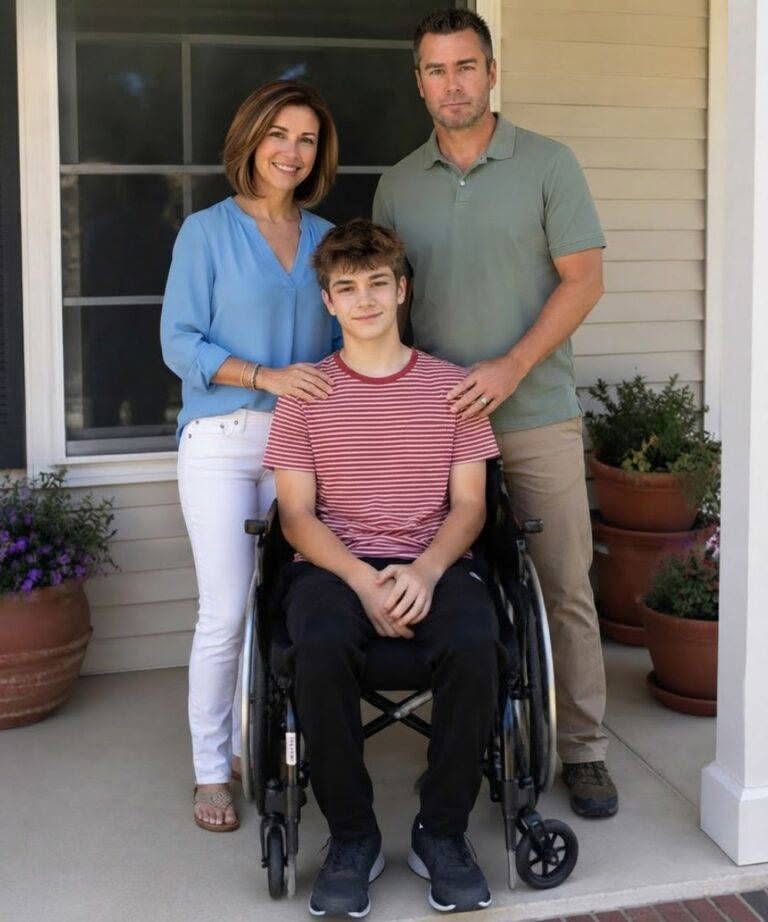
My name is Cyra. My son, Liam, has used a wheelchair since he was a little boy. Not once did I look at him and wish he were different. He was bright, funny, kind, and unbelievably sharp. He could solve problems that left adults confused, and he always knew how to make people smile when they needed it most. But Greg could never let go of the son he had imagined.
In Greg’s family, football was more than a sport. It was tradition. His father had been a respected high school coach, and Greg often spoke about Friday night games under stadium lights as if they were sacred memories.
“When we have a son,” he once told me when we were dating, “I’ll teach him everything my dad taught me.”
Back then, I thought it was sweet. Neither of us knew life would choose another path. Liam was three when doctors finally gave us a diagnosis that explained why walking had become so difficult for him. For years, we had gone from specialist to specialist, hoping someone would say it was temporary. It wasn’t. I still remember sitting in that small exam room while the doctor explained everything gently. Greg barely spoke on the drive home.
For weeks, he disappeared into work. Then something inside him changed, not suddenly, but slowly. First, he stopped talking about football. Then he stopped coming with me to Liam’s therapy appointments. After that, every setback became my fault.
“If you had noticed earlier…”
“If you had pushed the doctors harder…”
“If your family didn’t have those medical issues…”
He rarely finished the sentence. He didn’t need to. The blame always hung in the air. As Liam grew older, Greg learned how to hide cruelty inside jokes. When neighbors bragged about their sons making teams or winning games, Greg would laugh and say, “Guess I won’t be shopping for football gear.” People would laugh awkwardly. I would force a smile. Liam would look away.
Some nights, after Liam had gone to sleep, Greg would stand by the kitchen window and stare outside.
“You know what hurts?” he said once.
“What?”
“I see fathers throwing footballs with their sons at the park.”
I stayed quiet.
“They don’t even know how lucky they are.”
“I know,” I whispered.
Greg turned to me, his voice suddenly cold.
“No. You don’t.”
The words hurt, but the look hurt more. It was the look of a man who believed I had personally stolen his dream. For years, I carried guilt that was never mine. Logically, I knew I had not caused Liam’s condition. Doctors had told us that many times. But when someone you love blames you long enough, a small part of you starts to believe it.
Only Liam kept me steady. When he was twelve, I apologized after Greg made another thoughtless comment.
“I’m sorry, sweetheart,” I said.
Liam looked confused.
“For what?”
“For… everything.”
He smiled softly.
“Mom, you didn’t do anything.”
Tears filled my eyes. He squeezed my hand.
“You know what Coach Mara told me?”
I frowned.
“Who’s Coach Mara?”
“The adaptive basketball coach.”
I had forgotten he had been volunteering with the community sports program.
“He said people spend too much time thinking about what they can’t do.”
“And?”
“And they miss everything they can do.”
I laughed through my tears.
“That’s very wise.”
“I know,” he said with a grin.
That was Liam. He could find light almost anywhere. Greg rarely saw it. During high school, Liam collected award after award: academic honors, volunteer recognition, scholarships, and praise from teachers. One afternoon, our mailbox was packed with college letters. I spread them across the dining table and called him in.
“Liam!”
He rolled into the room, eyes wide.
“Seriously?”
I nodded.
“They keep coming.”
A few minutes later, Greg walked in from work. He glanced at the envelopes.
“What’s all this?”
“College offers,” I said proudly.
Liam had barely opened the first letter before Greg shrugged.
“Good.”
Then he went upstairs. That was all. No hug. No congratulations. No pride. Just one word. I watched Liam carefully. He still smiled.
“I guess that’s something.”
My heart cracked. Later that night, I confronted Greg.
“Could you have shown any less interest?”
“What are you talking about?”
“Our son has universities fighting for him.”
Greg loosened his tie.
“So?”
“So?” I stared at him. “He worked so hard.”
Greg sighed.
“Cyra, I said good.”
“That isn’t enough.”
“It should be.”
I couldn’t hold back.
“Would it have been enough if he had scored a winning touchdown?”
Greg’s face tightened.
“This again?”
“No,” I said. “This has always been about you.”
He pointed toward the living room.
“I didn’t ask for this life.”
I froze. Neither of us spoke. Then he added quietly.
“I had dreams.”
“So did I,” I said.
He looked away.
“I know.”
But no apology came. Only silence. Liam never said he heard that conversation. At the time, I assumed he hadn’t. Now I know he noticed far more than we realized.
PART 2
Despite everything, Liam graduated at the top of his class. The principal praised his strength and determination in front of hundreds of families. Parents stood and applauded. I cried through most of the ceremony. Greg clapped politely, nothing more. Liam was accepted into several excellent universities. He eventually chose one known for engineering and assistive technology.
“I want to build things that make life easier for people,” he told me.
“You already make people’s lives better,” I said, kissing his forehead.
He smiled.
The weeks before his eighteenth birthday passed quickly. My sister Nora insisted we throw him a real celebration at our house.
“He’s becoming an adult,” she said. “That deserves a party.”
Greg agreed without arguing. For a moment, I let myself hope. Maybe things were finally changing. Maybe Liam’s achievements had softened something in him. I spent days getting ready. I baked Liam’s favorite chocolate cake. Nora decorated the backyard with blue and silver balloons. My brother Owen grilled burgers. Neighbors came. Some of Liam’s teachers stopped by. Coach Mara arrived with a wrapped gift.
The yard was full of laughter. For a few hours, we looked like the family I had always wanted. Greg even smiled while talking to relatives. Watching him, I wondered if the bitterness had finally loosened its grip. Dinner ended. Cake was served. Everyone gathered around Liam. He looked happier than I had seen him in a long time. Nora handed him a glass of sparkling cider.
“Birthday toast!” she announced.
Everyone lifted their glasses. Greg stood beside me, smiling proudly for the first time in years. Liam looked around the yard and thanked each guest. Then he turned toward us. Everyone seemed to notice the change in his face. He was not angry. He was not nervous. He was calm. Almost too calm.
“I want to make a toast to my parents,” he began.
The conversations faded. Greg put an arm around my shoulders. Liam looked at both of us.
“The truth is, I know what has been happening in this family for years.”
Greg’s smile disappeared. Liam took a slow breath.
“But there is something you don’t know about me.”
The backyard went completely still.
“I heard every argument you thought happened after I was asleep.”
No one moved.
“I heard every joke Dad made about me.”
Greg shifted uncomfortably.
“I heard every time Mom tried to defend both of us.”
I wanted to stop him, to protect him, but I couldn’t move.
“I know Mom thought she was hiding your resentment from me,” Liam said gently. “But walls are thinner than people think.”
Greg swallowed.
“Liam…”
My son lifted one hand.
“Please let me finish.”
His voice was not angry. That made it even harder.
“I also know Dad blamed Mom for my disability.”
Several relatives looked at one another. Nora lowered her eyes. Coach Mara folded her arms. Greg forced a nervous laugh.
“Son, this isn’t the right time.”
“I think it is exactly the right time.”
Liam’s expression stayed steady.
“You spent eighteen years believing Mom took something from you.”
Greg glanced around at the guests.
“Can we talk about this privately?”
“No,” Liam said. “You made Mom carry it privately long enough.”
Tears slipped down my face before I realized I was crying. Liam smiled at me gently.
“It’s okay, Mom.”
Then he looked back at Greg.
“I know you dreamed of coaching football.”
Greg gave a small nod.
“I know Grandpa did that with you.”
Another nod.
“And I know every time you saw fathers playing with their sons, you looked at Mom like she had stolen your future.”
Greg’s face turned red. He knew where this was going.
“I was disappointed,” he said.
“No,” Liam replied calmly. “You were cruel.”
The words landed heavily. No one spoke. Then Nora’s voice trembled through the silence.
“He’s right, Greg. Cyra has carried guilt for eighteen years that never belonged to her.”
Owen shook his head slowly.
“We all saw pieces of it,” he admitted. “I wish we had spoken sooner.”
Liam continued.
“I used to wonder why I wasn’t enough.”
Greg stared at the ground.
“I thought maybe if I got better grades…”
Liam gave a sad smile.
“So I became valedictorian.”
Silence.
“I thought maybe if I earned scholarships…”
He shrugged.
“So I worked harder than everyone.”
Still silence.
“I thought maybe if I volunteered, helped people, stayed positive, and never complained…”
His voice broke for the first time.
“…maybe Dad would finally see me.”
I covered my mouth. Nora wiped her tears.
“But eventually,” Liam said, “I realized the problem was never me.”
He looked straight at Greg.
“It was the dream you refused to release.”
Greg finally spoke.
“It’s not that I didn’t love you…”
“I know,” Liam said. “But love should not be something people have to guess.”
That sentence seemed to drain the air from Greg’s lungs.
“You told Mom she ruined your life.”
Greg looked horrified.
“I…”
“You said you didn’t ask for this life.”
“I was angry.”
“For eighteen years?”
No one could argue.
PART 3
Then Liam reached into the pocket on the side of his wheelchair and pulled out a folded stack of papers.
“I’ve been keeping something.”
He unfolded them carefully.
“I started writing when I was ten.”
I stared at him.
“You write?”
He smiled faintly.
“Every birthday.”
Greg frowned.
“What kind of letters?”
“The kind I hoped I would never need.”
Liam looked down and read from the first page.
“Dear Future Me, Dad didn’t come to my game today, but Mom cheered loudly enough for both of them. Don’t let that make you think you are worth less.”
I broke down. Liam lifted another page.
“Dear Future Me, if Dad ever tells you he is proud of you, remember how long Mom waited to hear those words too.”
Greg covered his face. Then Liam read again.
“Dear Future Me, don’t become someone who blames others for the life you have. Be thankful for the people who stay.”
Quiet sobs filled the yard. Greg slowly lowered his hands.
“I didn’t know.”
“No,” Liam said, folding the papers again. “You didn’t.”
He looked at me.
“Mom protected you for eighteen years.”
I shook my head.
“I wasn’t protecting him.”
“You were,” Liam said softly. “You kept telling everyone Dad was just stressed.”
He was right. For years, I had made excuses because admitting the truth meant admitting our family was broken. Then Liam faced Greg again.
“I don’t hate you.”
Greg looked up with fragile hope.
“But I won’t let Mom keep carrying blame that was never hers.”
Greg took one hesitant step forward.
“I was wrong.”
No one answered. He took another step.
“I spent years grieving a life that never existed.”
His voice shook.
“And while I was doing that…”
He looked at Liam.
“…I missed the incredible son right in front of me.”
Liam watched him silently. Greg’s eyes filled with tears.
“I blamed your mother because blaming myself was harder.”
Then he turned to me.
“I couldn’t accept that life does not always follow our plans.”
I had imagined hearing those words so many times. But when they finally came, I only felt tired.
“You made me believe I had failed both of you,” I said quietly.
Greg nodded.
“I know.”
“No,” I said, wiping my cheeks. “I don’t think you do.”
He lowered his head.
“I watched you celebrate other people’s sons while barely seeing your own.”
His shoulders dropped.
“I know.”
“You let Liam wonder if he was enough.”
“I know.”
“You let me believe I deserved your resentment.”
Greg began crying openly.
“I know.”
Coach Mara stepped forward then.
“I’ve coached hundreds of young people,” she said.
Everyone turned toward her.
“Some became great athletes.”
She smiled at Liam.
“But very few became the kind of person others hope to be.”
She placed a hand on his shoulder.
“Your son already is.”
Then she looked at Greg.
“You should have been proud of him long before tonight.”
Owen quietly began clapping. Then another relative joined. Soon almost everyone was applauding. Not for the confrontation, but for Liam, for the young man he had become despite the pain.
Greg stood alone. For the first time, no one admired him. They looked at him with disappointment. Relatives moved toward Liam instead, hugging him one by one. Greg remained where he was, and for once, nobody rescued him with excuses.
After the guests began leaving, Greg approached us again.
“I made an appointment,” he said.
I frowned.
“With who?”
“A therapist.”
Liam looked surprised.
“I should have done it years ago,” Greg admitted.
Then he turned to me.
“If you allow me, I want to spend however long it takes earning back your trust.”
I did not answer right away. Some wounds do not heal because someone finally says the right words. They heal because actions change.
“I don’t know what happens next,” I said honestly.
Greg nodded.
“I understand.”
He looked at Liam.
“I’ll understand if you never forgive me.”
Liam was quiet for several seconds.
“Forgiveness is not the same as pretending nothing happened.”
Greg nodded again.
“I know.”
“But if you truly want to change…”
Liam glanced at me.
“…then start by apologizing to the person who deserved your support from the beginning.”
Greg turned to me, not dramatically, not quickly, just honestly.
“I’m sorry, Cyra.”
No excuses. No blame. No explanation. Only the words I had waited eighteen years to hear.
The next morning, before Liam woke up, I found Greg in the garage. He was assembling a storage cart for Liam’s dorm room. Boxes were stacked neatly nearby, and a supply list sat beside his toolbox. He looked up when he saw me.
“I checked Liam’s desk measurements online,” he said quietly. “I wanted to make sure this would fit underneath.”
I did not know what to say. It was not a grand gesture. But for the first time in years, I saw Greg thinking about Liam’s future instead of mourning the one he had imagined. Whether our marriage would survive, I honestly did not know. But one thing had changed. The weight I had carried for almost twenty years no longer belonged to me.
A few weeks later, Liam left for college. Greg insisted on helping him move into his dorm. He carried every box he could and spent nearly an hour arranging the furniture so Liam could move around comfortably. Before we left, Greg hugged him tightly.
“I’m proud of you, son,” he said, his voice breaking.
Liam smiled.
“Thank you, Dad.”
As I watched Liam roll through the university gates on his first day, smiling with quiet confidence, I finally understood something I should have known years ago. My husband had spent eighteen years grieving the son he imagined. But I had been blessed with the son who was real. And that son taught both of us the greatest lesson of our lives.

