
At 2:07 on a Tuesday morning, my phone lit up beside the bed with a message that ended twenty-three years of marriage: “I ran away with your best friend. We’re never coming back.” Beneath it was a photograph of my husband, Ethan, standing barefoot on a Cancun beach with Rachel, the woman who had sat at my table every Sunday and knew every secret I had ever shared. They raised champagne glasses toward the camera while she wore the sapphire necklace I had given her for her forty-fifth birthday. I stared at the picture until the shock hardened into something colder and far more useful. Ethan’s construction company was barely surviving, Rachel had been unemployed for almost a year, and neither of them could afford the luxury resort visible behind them. I opened my banking app and found thousands of dollars in charges for a private yacht, oceanfront dinners, a boutique hotel, and spa treatments—all billed to supplementary cards attached to my account. Before sunrise, I canceled every card, changed every password, secured every financial account, and hired a locksmith to replace every lock on the house.
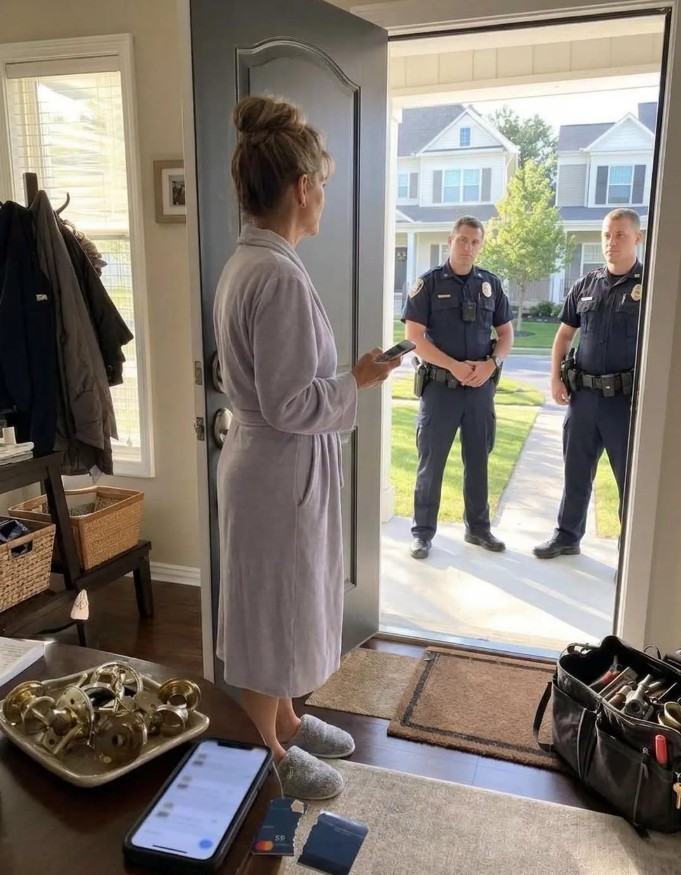
I was forty-five and worked as a senior accountant for a logistics company outside Columbus, Ohio, so I understood exactly how quickly careless spending could become financial ruin. For years, I had subsidized Ethan’s struggling business, covered household expenses, and allowed him to use a card connected to my personal credit line. Rachel also had an emergency card I had given her after her wallet was stolen during a trip overseas, and I had never formally removed her as an authorized user. The brick house Ethan called “ours” had actually been purchased in my maiden name with a $310,000 inheritance from my grandmother six months before our wedding, and I had never added him to the deed or mortgage. At 7:18 the next morning, two police officers arrived after Ethan complained that I had illegally frozen joint assets and locked him out of his marital home. I calmly showed them the property documents, account records, his message announcing that he was never returning, and the photograph from Mexico. Officer Daniels agreed that I had every right to secure my property and revoke access to cards issued solely in my name. Then, while reviewing the recent transactions for the officers, I noticed an unfamiliar $8,000 electronic transfer hidden among Ethan’s business reimbursements.
I searched deeper and uncovered additional transfers of $6,000, $4,500, and $9,200, all routed to the same outside account over ten months. By noon, nearly $40,000 in missing funds had surfaced, along with payments for a downtown apartment, a luxury vehicle deposit, and recurring “consulting” fees that had nothing to do with Ethan’s company. I called Lauren Hayes, a financial-litigation lawyer known for following money trails other people hoped would stay buried, and she arrived with a laptop before the afternoon was over. The digital authorizations had originated from Ethan’s office, where someone had copied my electronic signature from an old tax document and used it to approve transfers without my knowledge. The apartment lease listed Rachel as the tenant, meaning I had unknowingly financed the home where my husband had been meeting my closest friend. A security alert then showed repeated attempts from Cancun to enter my cloud storage and banking records after the cards stopped working. Lauren closed the computer, looked directly at me, and said, “They did not run away for love, Olivia—they ran because they believed they had already stolen enough to start over.”
Less than forty-eight hours later, Ethan and Rachel returned in a battered taxi, dragging expensive luggage and demanding entry through my newly secured front door. I handed Ethan a petition for divorce, an emergency financial injunction, and an order requiring him to preserve every asset and business record while police officers stood at the curb. My attorney traced the stolen money through the hidden account, while a forensic specialist documented the cloned signature, falsified authorizations, apartment lease, and Mexican charges. In court, Ethan tried to describe the transfers as ordinary marital spending, but the banking logs proved they were deliberate and concealed. The judge ruled that my home, retirement investment accounts, insurance policies, inherited estate funds, and other premarital assets belonged solely to me, leaving Ethan with no claim to the property or mortgage equity. Rachel admitted she had seen my name on a bank statement months before the trip but continued accepting money and living in the apartment. After Ethan acknowledged under oath that he had bypassed the bank’s security process, the court referred the evidence for a separate fraud investigation and ordered restitution from his remaining business assets.
Three months later, the divorce was finalized in a quiet conference room, and Ethan looked older than the man who had smiled so confidently from that beach. Rachel had begun cooperating with investigators, and their relationship ended almost as quickly as the money disappeared. I removed Ethan’s heavy furniture, replaced our anniversary photographs, opened the curtains, and discovered that silence could feel peaceful rather than lonely. I also began volunteering at a local women’s shelter, helping people understand credit reports, hidden debt, account access, and the small financial warning signs that are easy to dismiss inside a long relationship. The first restitution payment went into a separate account I named the Garden Fund, which eventually paid for raised cedar beds, lavender, tomatoes, and an oak bench beneath the maple tree. When an unknown number later sent a message asking me to talk, I deleted it without replying and blocked the caller. Ethan believed he had escaped with my future, but all he had taken was the life I had already outgrown; what remained was my home, my security, my name, and the peace I had finally chosen to protect.

