
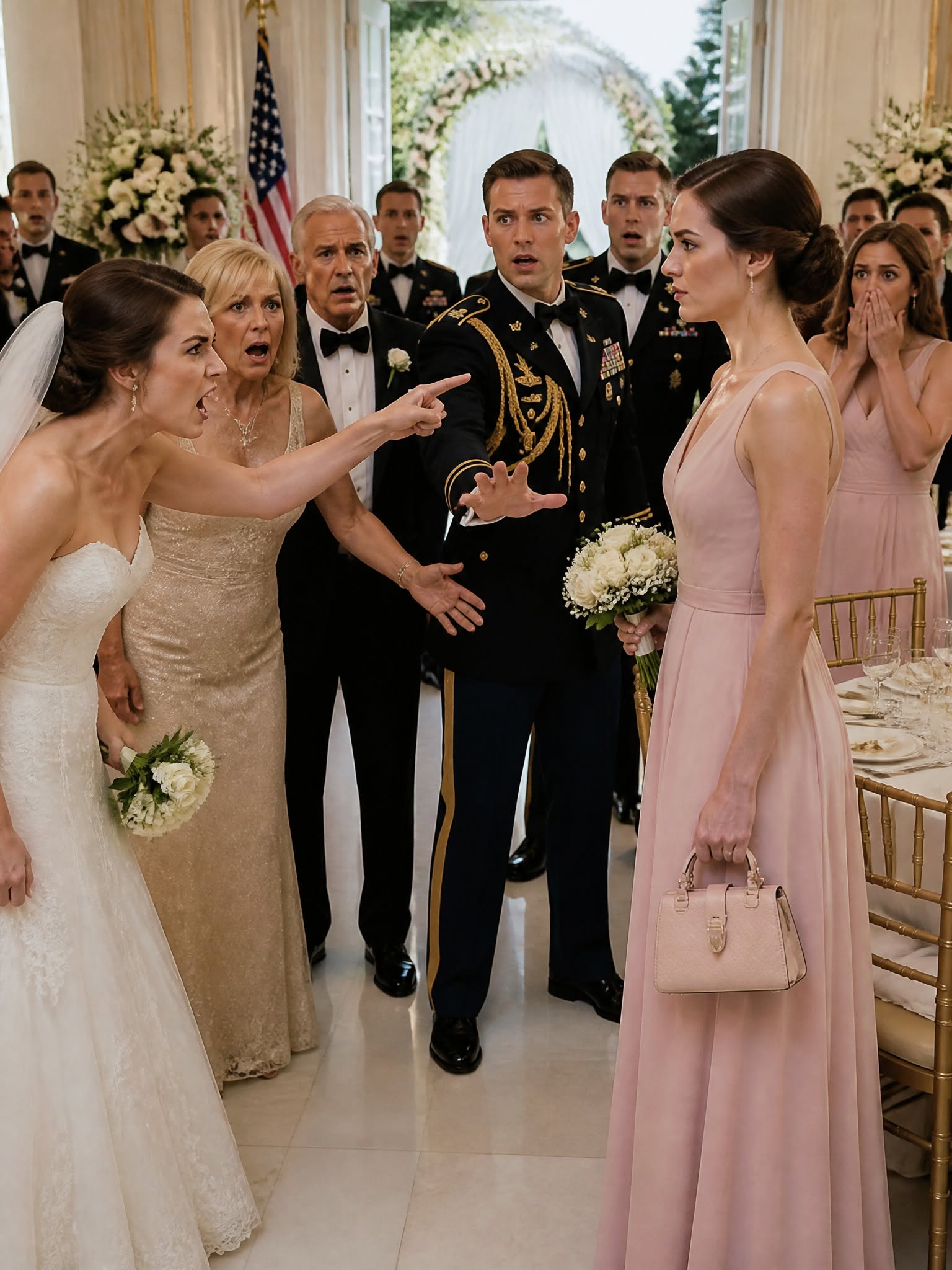
My sister claimed my military uniform would ‘trash her wedding,’ so I sucked it up and wore the bridesmaid dress instead. But right in the middle of the reception, a NATO Prince suddenly burst in, shocking every guest in the room as his eyes scanned the crowd for me: ‘Where is Sergeant First Class Aldridge?
Part 1: The Dress That Did Not Belong to Me
The pale pink dress scratched my collarbone every time I breathed.
I stood in front of the mirror in the bridesmaid guest room, tugging at the neckline as if I could negotiate with the delicate chiffon. It was expensive, soft, feminine, and harmless—exactly the kind of dress my younger sister wanted me to wear.
It was also exactly the kind of dress that made me feel erased from my own life.
A few steps away, my uniform still hung on the closet door. Dark blue. Perfectly pressed. Brass buttons polished bright. My ribbons were lined neatly inside the jacket, and above the pocket was the medical badge I had earned after twelve years in the Army.
I reached toward the garment bag zipper, then stopped.
The last time I wore that uniform to a family event, my mother smiled too brightly and said, “Maybe next time, wear something softer, honey. People can feel intimidated.”
People.
She meant her friends, relatives, donors, neighbors, and anyone else who might ask questions that pulled attention away from my sister, Brielle.
A knock sounded at the door, but Brielle came in before I could answer. She wore a white silk robe embroidered with her initials, her blond hair pinned in glossy curls, and her engagement ring sparkled so fiercely it looked like it was signaling aircraft.
She looked me up and down.
“Good,” she said. “You changed.”
My hand stayed near the garment bag.
“I never agreed not to wear my uniform.”
Brielle’s smile tightened.
“Mireya,” she said, using the voice she used with florists, chefs, and anyone who threatened her perfect vision. “We talked about this.”
“You talked. I listened.”
“It’s my wedding.”
“I know.”
“And I deserve one day where everything looks beautiful.”
I looked down at the dress.
“Beautiful means I have to look like a cupcake liner?”
Her eyes flicked toward the uniform bag.
“That outfit is too much,” she said. “It feels… intense.”
“Intense?”
“You know what I mean.”
“No. I really don’t.”
Brielle stepped closer and lowered her voice as if the walls might report her to the wedding planner.
“Preston’s family is important,” she said. “His father knows half the state. There will be donors, judges, diplomats, people from Washington. If his plane lands on time, Prince Alaric will be there too.”
I almost laughed.
“So?”
“So this is not one of your military dinners.”
That sentence sat between us.
Not because it was clever, but because it was true.
Brielle glanced at the uniform as if it were something unpleasant left on a chair.
“I don’t want guests asking about deployments at my reception,” she said. “I don’t want the photographer taking dramatic pictures of you with medals while I’m in a wedding dress. I don’t want today’s story to become my sister the soldier.”
“The uniform is part of who I am.”
“Not today.”
She said it gently.
That made it worse.
I had been yelled at by panicked officers, exhausted doctors, and helicopter pilots who treated dust storms like personality traits. I could handle anger. Anger was cleaner than this. This was Brielle calmly telling me where I belonged.
Behind her.
Quiet.
Color-coordinated.
She touched my sleeve lightly, as if inspecting merchandise.
“You look pretty,” she said. “Normal. Soft. Like family.”
Normal.
Not respected. Not strong. Not brave.
Normal.
When she left, the room felt quieter than before. I stood there for a long time, the dress scratching my skin, my uniform hanging silently in front of me. I thought about all the times my family said they were proud of me, then changed the subject before anyone could hear the details. I thought about how my father introduced Brielle as “our beautiful girl” and me as “the disciplined one,” like I was a household appliance that had never broken.
Then I zipped the garment bag shut.
Not because Brielle was right.
Because I was tired.
And as I followed the voices downstairs, I had the cold feeling that the most humiliating part of the day had not happened yet.
Part 2: The Perfect Wedding
The wedding was held at Larkspur Hall, a private estate outside Charleston with white columns, green lawns, and a driveway that made every car look more expensive than it really was.
Everything smelled like lilies, hairspray, and money.
In the bridal room, my mother, Celestine, stood behind Brielle, fussing over the veil as if she were handling a national emergency. My father, Ronan Vale, stood near the window, rehearsing greetings under his breath.
“Governor, what an honor.”
“Judge Calloway, a pleasure.”
“Your Highness, welcome to our family celebration.”
He shook hands with the air, released it, then practiced again.
When he saw me, his eyes dropped to the dress. Relief spread across his face.
“Good. Very good.”
Not “You look beautiful.”
Not “Thank you for coming.”
Just good.
As if I had passed inspection.
My mother turned and pressed a hand to her chest.
“Oh, thank goodness,” she said. “You look so feminine.”
I almost asked what I normally looked like, but I already knew. To them, my uniform made me hard. My work made me difficult. My rank made dinner conversations awkward. The years I spent as a medic in military hospitals and field units had become a family inconvenience.
Brielle stood in the middle of the room like a portrait of herself. White gown, lace sleeves, tiny waist, perfect hair, perfect smile. She truly looked beautiful, and for one honest second, I was happy for her.
Then she looked past me at the uniform bag an assistant had just carried in.
“Can someone move that somewhere else?”
Nobody asked what “that” was.
A bridesmaid took my uniform bag and hid it behind a rack of spare dresses.
That was how easy it was.
Twelve years of service disappeared behind tulle.
During family photos, the photographer placed me slightly behind my parents.
“Move a little to the left.”
I moved.
“No, farther back.”
I moved again.
“Perfect.”
Of course it was perfect.
From that angle, half my body was hidden behind my father’s shoulder.
Brielle glowed in every frame. Preston, her groom, stood beside her looking polished and cheerful. His mother, Vivienne Fairchild, kissed Brielle on both cheeks and called her “the future of this family.”
After that, the ceremony began in the garden. Brielle walked beneath a canopy of white roses, and Preston’s eyes filled with tears when he saw her. For a few minutes, everything softened. The cameras, politics, and performance faded behind something real.
She loved him.
I could see that.
That was why the next part hurt more.
Brielle was not incapable of love.
She was simply selective about where love was allowed to exist.
At the reception, I found my seat. Family section. Near the head table, visible enough for photos but not close enough for real conversation.
My place card was printed in gold.
Mireya Vale.
No rank.
No title.
No trace of the life I had built.
A woman wearing pearls glanced at me and asked, “Are you one of the relatives?”
“The bride’s older sister,” I said.
“Oh,” she replied, already looking past my shoulder.
Fifteen minutes later, I understood something painful and clear.
My family had not invited me to stand beside them.
They had invited a version of me they could control.
So when no one was paying attention, I stood and left the table.
Part 3: The Service Corridor
I found the service corridor almost by accident.
Or maybe not by accident. Maybe some part of me had been looking for a place where people cared more about work than appearances.
The hallway behind the ballroom was narrow, hot, and loud. Staff rushed back and forth like traffic during rush hour. Someone called for more bread. Someone shouted table numbers. Plates clattered. Coffee machines hissed steam.
It smelled like roasted chicken, garlic butter, lemon, and industrial soap.
My shoulders relaxed for the first time all day.
A woman in a black catering jacket stopped beside a prep table and looked at me.
“You’re lost,” she said.
“Probably.”
“The wedding is that way.”
“I know.”
She waited. I did not leave.
Her name tag said Tamsin. She had sharp eyes, gray hair pulled into a tight bun, and the face of a woman who had survived too many rich people’s emergencies.
“Do you need something?” she asked.
I looked around. The dessert station was clogged. Two servers were trying to move in opposite directions with full trays. Special meal cards were stacked beside the wrong table chart. The coffee station was too close to the entrance, forcing every third person to turn sideways to squeeze through.
I pointed at the meal cards.
“Those are for tables twelve through eighteen, but the servers leaving from this side are serving tables one through six.”
Tamsin blinked.
“And the tray traffic is crossing right at the door,” I continued. “Move the coffee urn six feet down, and you’ll save about ten seconds every time someone goes in or out.”
She looked at the corridor, then at me.
“What do you do for a living?”
“I’m a medic.”
“Hospital?”
“Army.”
Her eyebrows lifted.
“That explains the eyes.”
“What eyes?”
“The kind that walk into a mess and start triaging furniture.”
I laughed.
Five minutes later, I was helping sort meal cards. Ten minutes later, I moved the coffee station. Twenty minutes later, someone handed me a clipboard, and no one remembered exactly who had given me authority.
That was fine.
Authority often appears by accident when something needs fixing.
In that corridor, no one cared that my dress was ugly. No one cared that my sister had banned my uniform. They only cared whether Table Fourteen’s gluten-free plate went out before sauce touched it. They cared whether the groom’s grandmother received her soup warm.
Simple problems.
Real problems.
Useful problems.
I had spent years in places where time mattered, supplies mattered, and one missed detail could become a catastrophe. This was not a battlefield. It was a wedding reception. But the structure was familiar.
Chaos.
Priorities.
People pretending not to panic.
Through the small round window in the kitchen door, I could see the ballroom. Brielle sat beneath a spray of white flowers, laughing as Preston whispered something in her ear. My mother stood beside Vivienne Fairchild, both of them smiling like diplomats. My father had trapped a judge near the bar.
From that side, everything looked perfect.
From this side, I could see the sweat holding it together.
Then applause rose from the ballroom.
Not wedding applause.
Sharper. Bigger. Hungrier.
A server pushed through the door and whispered, “He’s here.”
Tamsin asked, “Who?”
“The prince.”
The whole corridor froze.
Through the window, I saw Prince Alaric of Montreval enter. He was taller than I expected, wearing a black tuxedo that looked tailored to negotiation-level precision. His dark hair was touched with silver at the temples, and his posture was straight but not stiff.
The guests saw royalty.
I saw command.
The way he checked exits. The way his shoulders stayed balanced. The way he smiled without losing awareness of the room.
That was not only palace training.
That was field training.
And as his eyes swept across the ballroom, I had the strange feeling that the most powerful guest in the room was looking for something my family had tried to hide.
Part 4: The Man Who Remembered My Name
For twenty minutes, Prince Alaric played the perfect guest. He shook hands, posed for photos, accepted congratulations, and greeted Brielle and Preston with a polite smile that never quite reached his eyes.
The ballroom adored him. The Fairchild family looked radiant. My parents seemed reborn.
But through the kitchen door, I could see that he was not truly focused on them.
Tamsin glanced at me.
“You know him?”
I almost said no.
Then I stopped.
“Not socially.”
That was the safest answer.
Because I did know him, just not the way my family wanted to know him.
Years earlier, I had been assigned to a coalition medical support team during an overseas security operation. A transport vehicle overturned after an explosion near a damaged aid route. People were trapped. Dust filled the air. Radios screamed. Someone kept shouting that a second collapse might happen.
I remembered crawling under twisted metal.
I remembered the heat.
I remembered a hand gripping mine so tightly it hurt.
I remembered a commander standing in the dust, so calm that everyone around him became calmer too.
At the time, I did not care that he was a prince.
In the field, titles mattered less than pulse, airway, bleeding, and evacuation time.
I only learned later that the commander was Prince Alaric.
To me, he had simply been an officer trying to keep his people alive.
Apparently, to him, that day had not faded into memory as easily as I thought.
A server came in and whispered, “Something is happening at the prince’s table.”
I looked through the window.
Prince Alaric sat near the center of the ballroom. My father sat across from him, his back stiff. My mother leaned forward with her important-guest smile. Brielle stood nearby, still glowing, still believing every room would obey if she smiled correctly.
The prince spoke.
My father answered.
The prince spoke again.
My father’s smile weakened.
Another server whispered, “He asked about the older daughter.”
My fingers tightened around the clipboard.
Then a third server stepped through the door and said, “He asked by name. Mireya Vale.”
The corridor seemed to narrow.
“He called you Sergeant First Class Vale.”
No one in my family had ever called me that.
Not once.
Through the glass, I saw my mother’s face change. She laughed quickly, too brightly, and waved a hand the way she did whenever she dismissed one of my deployment stories at Thanksgiving.
I could not hear what she said.
I did not need to.
A minute later, a server brought the words to me.
“Your mother said you’re somewhere around here. She said you’re shy and don’t enjoy formal events.”
Tamsin coughed into her hand.
“Shy?”
Nola, a young server, looked at me.
“Are you shy?”
“I once yelled at a colonel until he moved two helicopters.”
“So probably not.”
In the ballroom, my father lifted his glass as if trying to close the subject. My mother smiled. Brielle tried to redirect the conversation toward a judge.
The prince did not drink.
He did not laugh.
He did not turn toward the judge.
He sat still.
And I knew my parents had made a mistake.
People who live inside appearances often think silence means agreement.
It does not.
Sometimes silence means the other person is deciding what to do next.
Prince Alaric leaned forward. The polite guest vanished, and the commander appeared. The tables nearest him quieted, then the next ones, then the whole room.
A server hurried in.
“He asked again.”
Tamsin said, “Asked what?”
The server swallowed.
“He asked, ‘Where is Sergeant First Class Vale?’”
My heartbeat did not speed up.
It slowed.
A medic learns that the body sometimes becomes calm when a situation turns serious. Noise fades. Details sharpen.
Then the prince stood.
I saw it through the glass.
He rose with a calmness that made the whole room lose its rhythm. My father stood halfway, then froze. My mother went pale. Brielle’s smile disappeared completely.
Even through the glass, I could read his lips.
“Where is she?”
It was not really a question.
It was a command wearing formal clothes.
All day, the ballroom had been looking at my sister.
Now the most important person in the building wanted to know why the bride’s older sister had disappeared.
Part 5: The Salute
The kitchen doors swung open hard enough to hit the rubber stops.
The first two men inside were not servers.
Security.
Black suits. Earpieces. Sharp eyes. Not aggressive, just professional.
Behind them came Prince Alaric.
Behind him came my parents.
Behind them came Brielle in her wedding gown, with Preston following like a man who had missed several important chapters of the story.
The service corridor froze.
A cook held a ladle suspended over a pot. Nola stopped with both hands around a tray. Tamsin stood beside me, her expression unreadable.
The prince walked straight toward me.
I think that was the worst part for my family.
He did not search the corridor.
He did not look confused.
He knew exactly who he was looking for.
I stood beside the prep table in that ridiculous pink dress, clipboard in hand, my hair slightly loosened from the heat of the kitchen, suddenly feeling more exposed than I ever had during a formal military inspection.
Prince Alaric stopped six feet away.
Military distance.
Respectful distance.
His gaze moved over the trays, the staff, the dress, the clipboard, the ballroom doors, my nervous mother, my father staring at me like I had become a stranger, and Brielle breathing too quickly beneath perfect makeup.
Then he looked directly at me.
“Sergeant First Class Vale.”
The title fell into the corridor like a blade.
Not loud.
Sharp.
I set the clipboard down.
“Your Highness.”
My mother inhaled.
Brielle looked from him to me.
“You two know each other?”
Neither of us answered.
That was answer enough.
The prince brought his heels together.
The sound was small, but every part of me recognized it.
Then he saluted me.
Not a polite gesture for photographers. Not a royal nod.
A real military salute.
Clean.
Precise.
Earned.
For one second, I forgot the dress, the wedding, the flowers, and my family watching me as if I had been pulled out of my own life.
Training took over.
I returned the salute.
Our hands lowered together.
The silence afterward was almost violent.
Prince Alaric’s voice stayed calm.
“My men survived because of you.”
No one moved.
He continued, “I have carried your name in my memory for years. I requested to be seated with the family of Sergeant First Class Mireya Vale, but I was told you were unavailable.”
My father opened his mouth.
No sound came out.
My mother spoke first, as she always did when control slipped from her hands.
“Your Highness, there has been a misunderstanding. Mireya does not like being the center of attention.”
The prince did not look at her.
“Is that so?”
His eyes stayed on me.
That question was not for my mother.
I could have protected them.
That was the habit. Smooth things over. Reduce tension. Make myself smaller so the room could keep functioning.
Instead, I told the truth.
“No.”
Brielle froze.
My mother whispered, “Mireya.”
I looked at her.
For years, I had heard my name in that tone. Warning. Correction. Pleading. As if my truth were a stain she needed to wipe away before guests saw it.
Not today.
“I was asked not to wear my uniform,” I said. “Then I was seated where I would not draw attention. When I realized that was the point, I left the table.”
The corridor went silent.
Tamsin lowered her head to hide a smile.
Brielle’s face hardened.
“That is not fair,” she said. “I only wanted the wedding to look elegant.”
I looked at her gown, the lace, the pearls, and the carefully pinned veil.
“It is elegant,” I said. “It just did not have room for me.”
Her eyes filled with tears, though I did not know whether they came from guilt or humiliation.
Maybe both.
My father finally found his voice.
“Mireya, this is not the time.”
I almost laughed.
That had been my family’s unofficial motto.
Not the time to talk about deployments.
Not the time to wear the uniform.
Not the time to mention injuries.
Not the time to be anything except convenient.
Prince Alaric turned slightly toward my father.
“When is the time to honor service, Mr. Vale?”
My father swallowed.
No one rescued him.
Not the judges. Not the donors. Not the Fairchilds.
No one.
The prince’s voice lowered.
“I have sat in many rooms full of powerful people. I have seen men with famous names say very little and expect applause. But I have also seen your daughter crawl into danger because men she barely knew needed saving.”
My mother lifted a hand to her throat.
Brielle looked at me as if she had never heard that story.
Maybe she never truly had.
The prince turned back to me.
“I came today because I heard your sister was getting married, and I thought I would finally have the chance to properly offer my respect.”
Then his eyes moved across the service corridor.
“This is not where I expected to find you.”
My face warmed.
I did not feel ashamed.
I felt seen.
And that was more dangerous.
Because when someone has grown used to being ignored, recognition can feel like standing too close to a flame.
Prince Alaric extended his hand.
Not like royalty.
Not for me to kiss.
But as one soldier to another.
“I will not return to that table unless you return with me.”
Behind him, Brielle made a small sound.
My father closed his eyes.
My mother whispered, “Oh God.”
The whole corridor waited.
And for the first time that day, everyone understood that the decision belonged to me.
Part 6: Returning to the Ballroom
I looked at the prince’s hand.
Then at my family.
I wanted to say I felt victorious, but I did not. Victory would have been cleaner. What I felt was heavier: sadness, the kind that had lived in my chest for so long it knew where everything belonged.
My mother looked desperate, but not exactly for me. She was desperate for the room waiting beyond the doors, for the whispers, for the wedding photos that would now carry a story she could not control.
Brielle whispered, “I didn’t mean to hurt you.”
I believed her.
That was the problem.
People can hurt you deeply without planning it. They can touch the same bruise for years and still be shocked when you finally step back.
“I know,” I said.
Her shoulders loosened slightly.
Then I finished.
“But you did.”
I took Prince Alaric’s hand.
The corridor seemed to exhale.
Nola smiled openly. A cook gave me a small nod. Tamsin leaned close as I passed and whispered, “Walk slowly.”
So I did.
The ballroom doors opened.
Three hundred faces turned toward us.
The string quartet faltered halfway through a note. A photographer lowered his camera, then raised it again because instinct is stronger than manners. Silence spread from table to table.
The prince did not hurry.
Neither did I.
We crossed the ballroom beneath chandeliers bright enough to make every glass sparkle. The dress still scratched. My shoes still hurt. My uniform was still hidden somewhere behind a rack of dresses.
But I was no longer hidden.
Whispers followed us.
“Who is she?”
“The bride’s sister.”
“Why did he salute her?”
“Sergeant something, I think.”
I kept my eyes forward.
At the VIP table, the chair beside Prince Alaric was still empty.
He pulled it out.
Not for show.
For respect.
I sat.
Only then did he sit.
The whole ballroom saw it.
Dinner resumed like a machine restarting after a power outage. People laughed in the wrong places because the rhythm of the room had shifted. Preston’s father gave a polished speech about family legacy. My father gave a short speech and lost his place twice. My mother stared at her napkin through most of dinner. Brielle smiled at guests, but the smile never reached her eyes.
I was not happy to see her suffer.
That surprised me.
A younger version of me might have wanted justice to explode like fireworks. But real justice is often quiet. It does not always make you happy. Sometimes it simply puts the weight back where it belongs.
Prince Alaric asked about my current work. I told him I was involved in trauma readiness training for military and civilian emergency teams.
He asked specific questions.
“What do they still fail to prepare for?” he asked.
“Communication collapse,” I said. “People imagine they will rise to the moment. Usually, they fall to their training.”
He nodded.
“Always.”
No one at that table asked me to simplify. No one changed the subject. No one became uncomfortable because I talked about field medicine.
For the first time in years, I spoke at a family event without feeling as if I had dragged mud across a clean floor.
After the cake cutting, my mother approached me near the edge of the ballroom. Her eyes were wet. Her lipstick had faded.
“Mireya,” she said. “Can we talk?”
I looked toward Brielle, standing with Preston near the dance floor.
“Now?”
My mother flinched because she understood that word.
All the times she had said “not now” to me.
She folded her hands.
“I didn’t realize.”
Maybe that was true.
But it still was not enough.
“You didn’t ask,” I said.
Her lips trembled.
“I thought you didn’t like attention.”
“I don’t like being used as decoration.”
She closed her eyes.
When she opened them, she looked smaller.
“Your father and I are proud of you.”
I studied her for a long time.
For years, I had wanted those words. I had imagined they would arrive like medicine.
But they came late, thin, and tired.
“I believe you want to be proud,” I said.
Pain crossed her face.
I did not take the words back.
Some truths are not cruel.
They are simply overdue.
Part 7: The Conversation on the Balcony
Brielle found me on the balcony after the first dance.
The sky above Larkspur Hall had turned deep blue, but the estate lights kept the terrace bright. Inside, music moved through the glass doors. The guests kept dancing because weddings are very good at swallowing discomfort and calling it celebration.
I stood near the railing with a glass of water.
Brielle came outside, holding part of her skirt in one hand.
For a moment, neither of us spoke.
Without the crowd around her, she looked younger.
“I didn’t know about the transport vehicle,” she said.
“I know.”
“You never told me.”
“I tried.”
She looked away.
That was enough. She remembered. Maybe not the details, but the moments when I started telling a story at dinner and my father cut in with football. The Christmas mornings when my mother asked us to keep things cheerful. The birthdays when Brielle said, “No offense, but military stories bring the mood down.”
The wind pushed her veil against her shoulder.
“I was jealous,” she said softly.
That surprised me.
“Of what?”
She gave one bitter laugh.
“Because you had something real.”
I turned toward her.
“Everyone thinks being the pretty one is easy,” she said. “And in some ways, it is. People notice you. They praise you. They make room for you. But after a while, you start wondering if there is anything underneath it. You walked into rooms, and people trusted you with their lives. I walked into rooms, and people asked who designed my dress.”
I listened.
Part of me softened.
Part of me stayed guarded.
Both parts were honest.
“So you made me smaller?” I asked.
Her face collapsed.
“I made the wedding bigger,” she whispered. “And I made anything that threatened it smaller.”
It was the first true thing she had said all day.
“I’m sorry,” she said.
Simple.
No performance.
No excuse.
No “but.”
That mattered.
But it did not erase everything.
“I accept that you’re sorry,” I said.
Brielle let out a shaky breath.
“But I am not going back to how things were.”
Her eyes lifted.
“I don’t expect you to.”
“Maybe you don’t. But Mom and Dad will.”
She went silent.
We both knew it.
In our family, apologies were often used as reset buttons. Someone said sorry, everyone hugged, and the old pattern returned in cleaner clothes.
Not this time.
“I will not be the quiet sister anymore,” I said. “I will not hide my work, my uniform, or my life to make everyone comfortable. If there is no room for all of me, I will not come.”
Brielle nodded slowly. Tears ran down her cheeks, but she did not argue.
This time, she let the discomfort remain.
A little later, Prince Alaric stepped onto the balcony. He stopped when he saw us.
“I can come back later,” he said.
Brielle quickly wiped her face.
“No. It’s fine.”
Then she did something I did not expect.
She turned to him and said, “Thank you for looking for her.”
Prince Alaric studied her for a moment.
“She should not have been difficult to find.”
Brielle received that sentence like a slap she knew she had earned.
“I know,” she said.
After she went back inside, the prince stood beside me at the railing.
“Families are complicated,” he said.
“That is the diplomatic way to say it.”
“I was raised in a palace. Diplomacy was cheaper than therapy.”
I laughed before I could stop myself.
He smiled, and for the first time that evening, he looked less like a royal guest and more like the commander I remembered in the dust and heat years ago.
We talked, not about status or titles, but about people.
The engineer who sang off-key while repairing a convoy. The medic who carried peppermint candies in every aid bag. The young driver who wrote letters to his little brother on receipt paper. The men who survived. The ones who did not.
It was not romantic.
It was better than that.
It was honest.
Before he left near midnight, Prince Alaric handed me a small card.
“If your training program ever needs international support, call me.”
I looked at the card.
No decorations. No giant royal seal meant to impress a ballroom. Just a name, a phone number, and an email.
“You came to a wedding and left with a trauma training proposal?”
He smiled.
“The evening improved.”
For the first time that day, I felt light.
Not because a prince had recognized me.
Because I finally understood that I had never needed my family to approve the truth before I lived in it.
Part 8: Starting From Here
Two weeks after the wedding, my parents invited me to dinner.
Not at their house.
At a restaurant.
Neutral ground.
That was how I knew they were serious, or at least frightened enough to act serious.
I wore my uniform.
Not because I had just come from work.
Because I wanted to.
My mother’s eyes filled the moment she saw me. My father’s face tightened, then settled into something like shame.
“You look…” he began.
I waited.
He swallowed.
“You look distinguished.”
Not perfect.
But effort.
I sat down.
For the first fifteen minutes, they apologized in pieces. My mother apologized for the dress. My father apologized for letting Brielle decide how I should appear. Then, slowly, the apologies moved backward through time.
The holiday comments.
The changed subjects.
The photos where I had been pushed to the edge.
The way they were proud of me in private but hid me in public.
My father looked down at his hands.
“I think I was intimidated by you,” he said.
That sentence truly surprised me.
“Me?”
He nodded.
“You left home and became someone I did not know how to guide. Brielle’s world made more sense to me. Weddings, connections, appearances. I understood that language. Your world made me feel useless.”
My mother touched her napkin to her lips.
“I told myself you didn’t need praise,” she said. “You were always so capable. Brielle needed reassurance. You seemed… solid.”
I looked at her.
“Solid things can still crack.”
She closed her eyes.
“I know.”
Maybe she knew.
Maybe she was beginning to.
Dinner did not fix us.
Life is not that generous.
But it showed me something important. My parents were not villains. They were limited. Proud in theory, uncomfortable in practice. They loved in ways that often failed to reach me.
That did not excuse them.
But it helped me stop carrying the question of why.
At the end of dinner, my mother asked, “Can we start over?”
I thought for a moment.
Then I shook my head.
“No.”
Her face fell.
I raised a hand.
“We can start from here. But we cannot erase what happened, and I will not pretend it did not matter.”
My father nodded slowly.
“From here,” he said.
That became the boundary.
Not forgiveness with wide-open doors.
Not punishment.
Something quieter.
Access with conditions.
Love without surrender.
Over the next few months, things changed slowly and unevenly. My mother asked about my training program and truly listened. My father came to a veterans’ medical fundraiser and did not introduce me as “the disciplined one.” He said, “This is my daughter, Sergeant First Class Mireya Vale.”
He stumbled over the rank once.
Then corrected himself.
Brielle called after her honeymoon. She did not ask me to comfort her. She did not try to turn the wedding story into a joke. She only said, “I found the uniform bag after we got back. I should never have let anyone hide it.”
“No,” I said. “You shouldn’t have.”
She cried.
I let her cry.
Then we talked about her new apartment, Preston’s terrible cooking, and the strange loneliness that came after spending a year at the center of everything.
We did not become best friends overnight.
We became more honest strangers who happened to be sisters.
That was better than pretending.
Part 9: Where I Chose to Stand
Prince Alaric kept his word.
Three months after the wedding, his office helped connect my trauma readiness training program with an international emergency medicine network. We built joint workshops for medics, firefighters, hospital teams, and disaster response units.
No chandeliers.
No giant flower arrangements.
No seating charts designed to please donors.
Just people learning how to keep others alive when order collapses.
The first training took place at a bright conference center outside Denver. I stood at the front of the room in uniform, looking at nurses, paramedics, medics, and emergency managers from six countries.
Prince Alaric sat in the second row.
No podium.
No personal spotlight.
Second row.
When I finished the opening session, he stood with everyone else and applauded. Not as a prince. As a man who understood the work.
Afterward, he shook my hand.
“Better than a wedding,” he said.
“Lower flower budget,” I replied.
“Major improvement.”
I laughed.
That evening, alone in my hotel room, I carefully hung my uniform in the closet and thought about the pink dress from Brielle’s wedding. I had donated it weeks earlier. Someone else could wear it to a garden party and feel beautiful. That was fine.
The dress had never been the enemy.
The enemy was disappearing to keep peace.
I had done that for too long.
I once thought recognition would arrive like thunder, loud enough to make everyone regret what they had done. But it came through a service corridor, between warming trays and tired staff, carried by someone who remembered what my family chose to forget.
But the real turning point happened before that.
It happened when I left the table.
When I stopped fighting for a seat that had to be paid for with silence.
When I chose the honest noise of the kitchen over the polished quiet of being overlooked.
My family still kept the wedding photos. In most of them, Brielle looked radiant. Preston looked happy. My parents looked proud, anxious, and painfully human.
There was one photo no one had planned.
The photographer caught the moment Prince Alaric and I walked back into the ballroom. I was wearing that ridiculous soft dress, my hair slightly loose, my face calm. He walked beside me with formal dignity. Behind us, the entire room had gone silent.
My mother once asked whether I wanted a copy.
I said yes.
Not because of the prince.
Not because of the guests.
Because when I looked at that photo, I did not see a woman being rescued.
I saw a woman who returned only after she had already chosen herself.
And that is the version of me my family has to know now.
The whole version.
The honored medic. The difficult daughter. The older sister who no longer blends into the background. The woman who learned that dignity does not depend on where someone else seats you.
Sometimes the front row is just another place to disappear.
Sometimes the service corridor is where you remember who you are.
And sometimes, when the right person asks, “Where is she?” the answer is simple.
She is standing exactly where she chose to stand.
THE END.

