
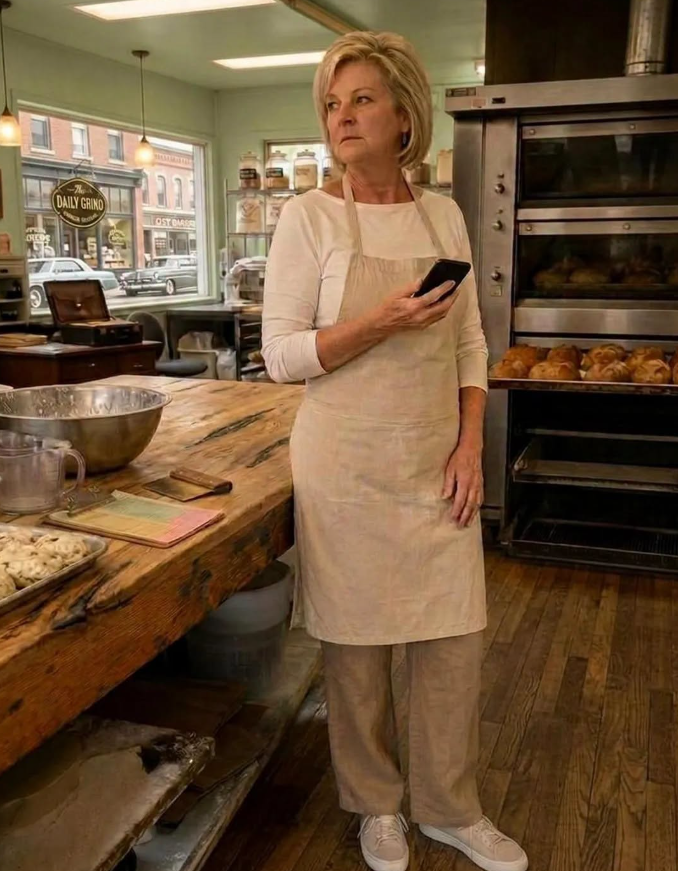
The first loaves were crackling on the cooling rack when my son called from the lake, his voice tight with panic. “Mom, what happened to the business account?” Evan demanded, while I could hear his wife, Marissa, questioning him in the background. His card had been declined at a gas station, and the banking app showed that his access had been removed. I slid another golden loaf onto the rack and looked around the kitchen my late husband, Raymond, and I had built together. The scarred worktable, old copper bowl, and flour-covered shelves had survived thirty-six years without anyone’s permission but ours. “You can’t access the account because I removed you,” I told him. The silence that followed was the first sign that my son finally understood I was no longer waiting for him to explain away what he had done.
Willa Jean’s Bakery had opened in 1987 with one secondhand oven, $8,400 in savings, and a handwritten sign Raymond painted above the door. After he passed four years ago, Evan began helping with deposits, vendor payments, payroll software, and online orders, and I was grateful enough not to notice when assistance slowly became authority. By sixty-eight, I was still arriving before dawn, making the same scones I had baked for decades, yet Marissa left me a three-page vacation checklist warning me not to make the next batch “too dry.” Before leaving with Evan, her mother, and three coolers, they informed me they would be unreachable at a lake house until Sunday. That same morning, I discovered more than $200 missing from the petty cash box, and my accountant later found over $800 in unexplained withdrawals. A longtime customer then mentioned that Evan had been telling people I planned to retire and that he and Marissa intended to convert my storage room into a modern catering venue. Hidden inside Raymond’s old desk, I found a five-figure renovation proposal, a zoning inquiry filed eleven weeks earlier, and a note in Marissa’s handwriting that read, “Need Mom’s signature on LLC transfer before bank meeting.”
I photographed every page and took the records to Adeline Strickler, the attorney Raymond had trusted with our property affairs. She confirmed that I remained the bakery’s sole owner, but she also warned me that Evan’s expanded banking authorization gave him far more control than I had understood when he rushed a document beneath my flour-covered hand the previous spring. My accountant, Fern Atwood, uncovered two transfers from business savings disguised as consulting expenses—one paid to a design company and another to a planning service connected to their renovation scheme. Evan had not inherited the bakery, purchased an ownership share, or received permission to reshape it; he had simply practiced acting like an owner until everyone around him stopped questioning it. Adeline contacted the bank, froze his access, preserved the transaction history, and prepared formal notices protecting both the bakery and the narrow parcel of land behind it. When Evan accused me of locking him out without a conversation, I reminded him that he had planned to remove my shelves, change my business, and secure financing without speaking to me first. Then he returned from the lake with Marissa beside him, walked into my kitchen after closing, and saw the folder waiting on the worktable.
I placed the zoning records, design proposal, transfer history, and Marissa’s handwritten note in front of them while Adeline remained available by phone. Evan admitted that he believed I was too old and tired to keep operating the bakery, while Marissa insisted their plan would improve revenue and turn the property into a better investment. I told them hard work was not suffering simply because they did not want to do it, and that my age did not give them ownership of my future. Fern’s audit documented every unauthorized withdrawal, while my attorney confirmed that the insurance policy, mortgage records, business account, land deed, and Raymond’s estate documents all remained legally under my control. I chose not to pursue charges immediately, but I required Evan to explain every dollar through counsel and warned that the evidence could be presented in court if he disputed the records or tried to access the property again. Then I placed the rear parcel into a revocable trust and established the Raymond Holt Community Kitchen Fund, ensuring that the land would someday provide licensed workspace for bakers who had talent but lacked money or commercial facilities. Evan’s name appeared nowhere in the ownership documents, and the design deposit Marissa and her mother had paid became their loss—not mine.
The fund soon welcomed three local women: Amara, who made Caribbean pastries from her apartment; Kelsey, a single mother building a hand-pie business; and June, a community-college student selling bread subscriptions from her dorm. They asked about oven schedules, liability coverage, wholesale pricing, and food-labeling rules, and the bakery slowly began to feel alive rather than guarded. Evan returned alone two months later and apologized without blaming his wife, his grief, or his father’s memory. When he asked whether he could work beside me again, I told him, “Not yet,” because love had survived, but trust had not. One cold December morning, I found a pair of work gloves hanging from the back door—the same kind Raymond once wore—and I placed them on a shelf where I could see them without pretending I was ready to use them. Above Raymond’s old desk, I pinned a photograph from our opening week with five words written on the back in his handwriting: “First week. Still standing.” The bakery had never been built for someone to take; it had been built for people willing to tend it.