
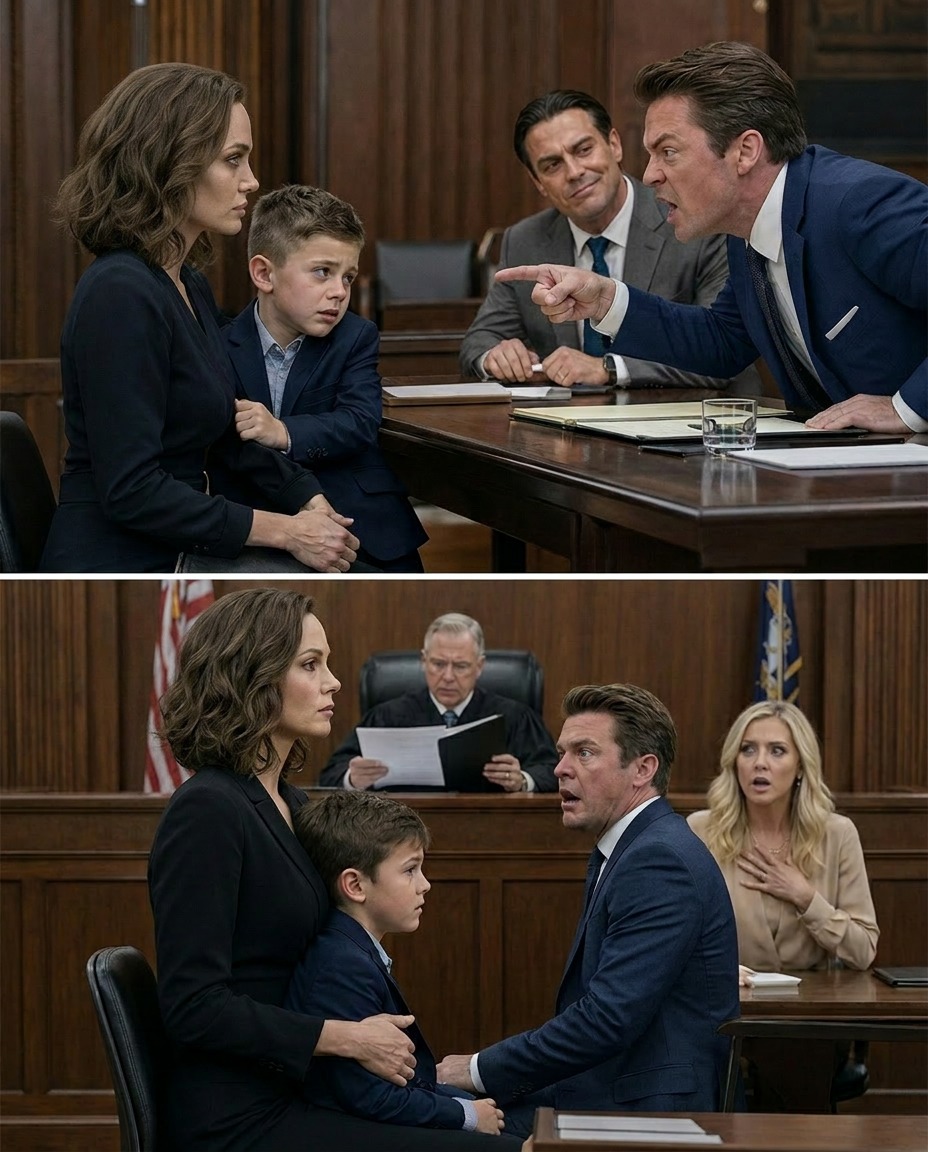
My husband asked me for a divorce. He said: “I want the house, the cars, everything… except the boy.” My lawyer begged me to fight. I said: “Give it all to him.” Everyone thought I had gone mad. At the final hearing, I signed everything over to him. He smiled… until his lawyer read the last page.
When Daniel told me he wanted a divorce, he did not raise his voice.
He sat across from me at the kitchen island beneath the skylight I had designed myself, folded his hands as if discussing lawn maintenance, and spoke in the calm tone he used whenever he wanted something to sound reasonable simply because he had said it without emotion.
“I want the house,” he said. “The cars. The savings. Everything.”
He paused, glanced once toward the staircase, and added almost lazily, “You can keep the boy.”
The boy. Not Ethan. Not our son. Just the boy.
Upstairs, Ethan was 8 years old, working through spelling words at his desk, whispering them aloud before writing them down. I could hear the faint shape of his voice through the ceiling. While Daniel divided our life into trophies and leftovers, Ethan was still upstairs spelling words, still expecting this house to mean home.
My chest tightened. I did not cry.
“When?” I asked.
Daniel seemed almost relieved. “We can do this cleanly. No drama. No dragging it out. You take Ethan, I take the assets, and we both move on.”
A week later I sat in Margaret Collins’s office. She had been practicing family law in Greenwich for 26 years. She listened to me once, took off her glasses, and stared.
“You want to give him everything,” she said.
“Yes.”
She dropped her pen. It rolled off the desk into her lap.
“Emma, you contributed financially to this marriage. You’re entitled to half at minimum. Full custody isn’t something we accept as a side note.”
“I understand.”
“Is he threatening you? Is there abuse?”
“No.”
“Then what is this?”
“The primary conflict,” I said, “already happened.”
She studied me. “That is not an answer.”
“It’s the only one I can give you today.”
Over the next 5 weeks Daniel and his attorney strutted through mediation as if collecting trophies. He never once asked for more time with Ethan. Never asked how school transitions would work or whether Ethan’s therapy and routines would be preserved. He only asked who would hold title to the house. Who would keep the investment accounts. Whether I was claiming any interest in the art collection.
Margaret would glance at me. I would say the same thing every time: “Let him have it.”
What Daniel did not know was that I had hired a forensic accountant three months before I hired Margaret.
Six months earlier, Daniel had grown reckless. Unexplained transfers from savings. Equity draws against the house. New lines of credit. When I asked, he dismissed everything with bored confidence. “Short-term repositioning. You wouldn’t understand the tax side.”
Then Ethan got sick one night in February and I went into Daniel’s office looking for the insurance card. In the second drawer, under a file labeled Quarterly Statements: three envelopes from lenders and a margin call notice printed in red.
I didn’t sleep that night.
Over the next week I began reading. Loan files. Private notes. Account screenshots with handwritten numbers in the margins.
The house had a second mortgage I knew nothing about. The brokerage account had been pledged as collateral. One car was leased through a vanity LLC with balloon terms. And the savings Daniel wanted in the divorce were already half gone — siphoned into failed speculative investments and, based on hotel charges, into a relationship with a woman who liked expensive weekends.
I hired Margaret knowing exactly what he was really asking for.
Not wealth. Burden. Not security. Liability wrapped in polished surfaces.
The final hearing took 19 minutes.
Daniel looked almost radiant in a charcoal suit — the tie I had bought him for our tenth anniversary. His attorney, Stephen Hale, had spent mediation wearing the smug patience of a man who mistook my silence for collapse.
The judge reviewed the agreement. A broad-faced woman with tired eyes and dry intelligence.
“Mrs. Mercer, do you understand that under this stipulation your husband receives the marital residence, both vehicles, the joint savings, the taxable investment account, and the contents listed in Schedule C?”
“Yes, Your Honor.”
“You understand this division is unusually imbalanced.”
“I do.”
Daniel smiled. Not at me. At the room. At the shape of his own success inside it.
He took the pen. Signed the main agreement. The custody acknowledgment. The property division schedule. The debt allocation page he barely glanced at.
Then he reached the final packet.
Stephen flipped the page toward him.
That was when the smile vanished. Not slowly. It simply stopped.
His eyes moved to the addendum. Then back to the prior page. Then to Stephen. Then to Margaret. Then finally to me.
“What is this?”
Stephen took the page, read four lines, and went pale beneath his tan.
The judge extended her hand. The document was passed forward.
She read.
Then she looked at Daniel.
Then at me.
Then she said, very carefully: “Counsel, this supplementary rider appears to attach full personal liability for all undisclosed debt instruments to Mr. Mercer as the receiving party of the encumbered assets. Including the second mortgage on the residence, the pledged brokerage collateral, and three margin accounts. Is that your client’s understanding?”
Stephen was no longer smiling.
“Your Honor, we may need a brief recess—”
“The document was submitted and acknowledged 48 hours prior,” Margaret said. “Exhibit D-4.”
Daniel looked at me.
For the first time since he had sat down at our kitchen island and told me he wanted everything, I saw something real on his face. Not the performance. The person under it. Afraid, finally, in the way people become afraid when they realize they got exactly what they asked for.
“Emma—”
The judge raised one hand. “Mr. Mercer, I am going to ask you once. Do you understand what you are signing?”
His lawyer leaned in. Whispered.
Daniel looked at the document.
He had spent months believing I was giving up. Believing I was devastated and irrational and incapable of seeing past grief. He had designed the entire proceeding around my anticipated collapse.
What he had signed, along with the house, the cars, the accounts, and the art, was every dollar of hidden debt he had accumulated. Two years of leveraged risk. Three failed margin accounts. The second mortgage. The balloon lease. All of it, now sole personal liability.
The assets were his.
So were the anchors.
He signed.
The judge accepted the documents.
Outside the courthouse, Daniel stood on the steps while his attorney made calls. I walked past him without slowing.
“Emma.”
I stopped.
He looked at me with the specific expression of a man who has just calculated a loss too large to fully process.
“You knew,” he said.
“Yes.”
“How long?”
“Long enough.”
He looked away toward the street. A taxi passed. A woman walked a dog. The world continued without pause.
“The house,” he said finally.
“Has a second mortgage you took without telling me,” I said. “The lender expects payment. You have 60 days before the first default notice.”
He said nothing.
I walked to the car where Ethan was waiting with my sister, who had picked him up from school. He had a drawing he wanted to show me of a robot he had invented that could do homework. I told him it was excellent and asked if it could do third-grade spelling words.
He said it could do anything.
I told him I believed him.
Part 2
The house on Chestnut Hill sold at foreclosure auction 14 months later.
Daniel had attempted, in the intervening time, every available restructuring: refinancing, consolidation, negotiated settlements with the margin lenders. All of it failed. The interest on the hidden debt had been compounding for longer than he had admitted even to himself. Without my income to offset it, without my quiet financial management to smooth the monthly gaps, the structure he had built came apart in the way overleveraged things always do — fast once it started, and thoroughly.
I heard about it through our mutual accountant, who was no longer mutual by then, who called to tell me as a professional courtesy.
I thanked him and hung up.
Ethan and I lived in a two-bedroom apartment in Riverside during that time. Smaller than anything we had known in the marriage. It had a bedroom with a window that faced east and let in the morning light in a way that made Ethan name it the golden room the first week we moved in. He kept his spelling words on a card taped to the wall.
I had a studio space down the hall where I took on residential design commissions. Modest at first. Then less modest.
I had rebuilt before. I knew how it went.
The only hard conversation was Ethan himself.
He was 9 by then and not fully able to understand what had happened, but children understand more than they can articulate. He knew the house was gone. He knew his father was somewhere different now and not part of the regular week. He was processing it in the way children do: episodically, in questions that arrived without warning.
One morning he asked me, while eating cereal, why Dad hadn’t wanted to keep him in the divorce.
I thought about what to say.
I thought about easy answers and incomplete ones.
Then I told him the truth in the clearest form I could make it.
“Your father wanted things that seemed valuable to him. I wanted what actually was valuable to me. That’s why you came with me.”
Ethan thought about this for a long time.
“What did he end up with?” he asked.
“Everything he asked for,” I said.
He nodded slowly, with the precise gravity of a child who suspects there is more to that sentence but has decided to accept it for now.
“Okay,” he said.
He went back to his cereal.
Outside the kitchen window, October had turned everything orange. A tree by the corner store had gone gold overnight. The morning light came through in long quiet bars across the floor.
I made my coffee and sat across from my son and watched him eat breakfast in the golden room and thought about all the things a woman gets to keep when she stops being afraid of what she might lose.
Everything that mattered.
That was what I had kept.
Everything that mattered.

